

"We came. We saw. He died"
- Hilary Clinton, Secretary of State,
  when Muamma Qaddafi was murdered.**

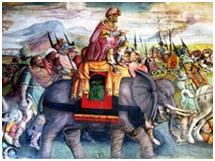
The indigenous people of North Africa are the Berbers. Many Berbers are stateless people because the places where they lived as a result of colonisation and imperialism. They lived in the region during the ancient time of the city of Carthage. The most famous of the Berbers was a Carthaginian called Hannibal. Although football fans would probably say the captain of the French soccer team, Zinedine Zidane, is a more famous Berber.
Other famous Berbers are: Masinissa • King of Numidia, North Africa, present day Algeria and Tunisia • Augustine of Hippo • bishop of Hippo Regius (Annaba) (395) • Krim Belkacem • Algerian revolutionary fighter, assassinated in 1970, allegedly by Algerian secret services • Édith Piaf • one of France’s most loved singers, her grandmother was Berber.
I studied Hannibal’s exploits in Latin at school. In sub-junior (Year 9) I had the privilege of being taught Latin by Brother ‘Doc’ Campbell. ‘Doc’ insisted that learning language meant learning customs, dress, history and culture.
My favourite story was Livy’s account of Hannibal’s passage through the Alps. One of the best parts of the story lies in the passage where Livy* describes how the Carthaginians overcame an impasse high up in the Alps:
The next task was to construct some sort of passable track down the precipice, for by no other route could the army proceed. It was necessary to cut through rock, a problem they solved by the ingenious application of heat and moisture; large trees were felled and lopped, and a huge pile of timber erected; this, with the opportune help of a strong wind, was set on fire, and when the rock was sufficiently heated the men’s rations of sour wine were flung upon it, to render it friable. They then got to work with picks on the heated rock, and opened a sort of zigzag track, to minimize the steepness of the descent, and were able, in consequence, to get the pack animals, and even the elephants, down it.
So Hannibal marched an army, which included 40 elephants, from Iberia (modern day Portugal, Spain, Andorra, and Gibraltar) over the Pyrenees and the Alps into northern Italy and defeated the Romans in a series of battles. War weary and with supplies cut off by politicians back home, Hannibal returned to Carthage never having marched on Rome itself.
It was written that Hannibal taught the Romans the meaning of fear.
Later Scipio led the Romans and laid waste to Carthage to exact his personal revenge. Hannibal’s brother, Hasdrubal, had killed Scipio’s father and uncle in a battle in Hispania.
Prior to the Battle of Zama there was one last chance for Carthage to be saved when Scipio and Hannibal met. Scipio had the better infantry and his trumpets would later stampede Hannibal’s war elephants to turn back the Carthaginians.
Beforehand they met to negotiate a settlement. Historians suggest that Scipio mistrusted Hannibal because his opponent had a reputation for trickery and ambush. Even though some Senators in Rome were opposed to Scipio’s campaign against Carthage, Scipio could make no settlement with Hannibal. Carthage was destroyed with huge loss of life.
So Tripoli – modern day Carthage – and the rest of Libya, was influenced by the Romans. It was also influenced by the Greeks. Alexander (‘the Great’) waged campaigns in the region — hence the name Alexandria, the most cosmopolitan of Egyptian cities.
Some time before people from Mesopotamia (present day Iraq) had traded with and exerted influence over Egypt. They had their own trading empire and religion to build. So they influenced the language and culture of the region. Arabic flourished because it was written down (in the Qur’an) while the oral indigenous languages died out. Arabic as a language spread out of its classical area of the Arabian peninsula and northern areas (South Anotalia- Turkey) Levant (Syria-Lebanon), Mesopotamia (Iraq.) Arabic was not the only language in these parts— like Hebrew, Arabic was only one of the languages of the Semitic tribes. ‘Pure’ Arabs were originally from Yemen in the southern part of the Arabian peninsular. Arabic spread to North Africa (including Libya) with the spread of Islam in the 7 th century. Nevertheless, there is a real distinction between Islam and Arab identity. Arabic is spoken by over 280 million people today. Even though 80% of Arabs are muslim, they are not defined by religion. This mistake is often made by the West. For example media reports here keep stressing that the current uprising in Bahrain is caused by tensions between the majority Shia and the Sunni Royal family. Yet Bahrain is one of the most secular and cosmopolitian places in the Arab world. How can religious differences explain a civil uprising based on calls for democratic rights?
Down through the years, across North Africa, a melting pot of Berber, Arab, Roman and Greek influence evolved.
But then Europeans see Mesopotamia as early European civilisation upon which the Greeks and Romans civilisation was built. Perhaps the pioneers of modern nationalist states want to have their society based on the first civilisations as a mark of pride.
The reality is we are all one humanity. Barbarity or military society is not confined to low society or to tribal life. People of modern states may like to view indigenous peoples as backward. This is not true. No matter what society, whether it be economically developed or undeveloped, all are capable of repression, but only the most highly developed are capable of imperial blunders. The Romans did so when they laid waste to Carthage. The US likewise when they destroyed Iraq.
Qaddafi like Hannibal lived in a Bedouin tent (even when he visited the UN in New York) and like the modern Berbers speaks Arabic and shares that culture. Michael Mansell, the Tasmanian Aboriginal leader, must have known this when he led a delegation to Libya to meet Qaddafi in 1987 saying: ‘(we hope) the Libyan people will offer us further support where needed”. One indigenous tribe to another. Of course the conservative press went collectively beserk when they heard aborigines were seeking outside help against the repressive regime here in Australia. Mansell, when asked if he would be accepting money from ‘terrorists’, replied: “We’ve been taking it from terrorists for 200 years!” [Libya – what really happened Pugganna June 1987 no 25 p6]
Since the modern colonial wars of France, Italy and Britain over the lands of the Berbers a resistance has been learnt. This resistance threatens to unify them against their former European colonial masters and if that happens the world will change. From the early 20th century this unity has been built. The Algerian war of independence against France (1954 to 1962) was one of the nastiest and bloody of the national liberation struggles. Only the US occupation of Iraq (2003-2011) matches its savagery. Bombings, intrigues, CIA plots and counterplots have made for intense suffering matching the evil of French military repression in Algeria and the violence it triggered depicted so well in the 1960s film, The Battle of Algiers.
Things changed in Libya upon the discovery of oil in the 1950s. It was no longer an impoverished state. Qaddafi led the revolution in 1969 that threw off the colonial puppet king and drove the Italian capitalists back to reconsider their position. Qaddafi nationalised the oil and rescued many of its people from poverty. But, like any bourgeois, Qaddafi imported and exploited the working class from Egypt, Tunisia, Palestine and from Africa, south and east. He entered into deals with the capitalists while preaching socialism. He tried to hold Libya together by linking up with tribal people and being like one of them. At the same time he set one of his sons up in a $2million apartment in London and sent him to the London School of Economics. This was not to learn about socialism. Qaddafi embraced European militants engaged in armed struggle and sent them money and guns — to the Irish Republican Army and the Italian Red Brigades to name two. The rising tide of left-wing radicalism in Europe was provoked in part by the national liberation struggles in Africa and the Middle East. Ironically a large minority of these Leftists began to show interest in the armed struggle that Qaddafi, among others, chose to fund.
By his own admission at the 2008 Arab Summit Qaddafi got lost in intrigue:
“We (Arabs) are enemies of one another, I’m sad to say. We all hate one another. We deceive one another. We gloat at the misfortune of one another. And we conspire against one another. Our intelligence agencies conspire against one another, instead of defending us against our enemies. We are the enemies of one another. An Arab’s enemy is another Arab’s friend.”
Of course Qaddafi himself was under pressure from the West.
In 1986, Ronald Reagan and Margaret Thatcher decided to kill Qaddafi by sending US air force F111s to bomb Tripoli and Benghazi. Qaddafi survived, left his brick house to live in a Bedouin tent and mourned the death of a baby daughter who was killed in the raid (some say she was adopted).
My old school song, Signum Fidei (Latin = ‘the sign of faith’) was sung to the tune of the US Marines’ Hymn ‘From the halls of Montezuma to the shores of Tripoli’. These shores of Tripoli are those in Libya. The school song did not use the same words at the US Marines hymn. It went something like ‘we come from every corner, from near and from far…’ But the idea was the same, to gee people up for battle. In the case of the school, battle took place on the football field.
From 1801-1805 the US had engaged in a war against pirates of the Barbary Coast who were raiding American merchant ships for loot and ransom. This was the First Barbary War also known as the Tripolitania War.
It was the first time in history that the United States flag was raised in victory on foreign soil.
Once again, in 2011, the US is keen to join in the fray in North African and the Gulf states.
This time to protect its oil and shipping interests.
As always there is much at stake.
From long ago, much of European colonial exploitation of Africa was through the Mediterranean states. In the late 19th century, imperialist exploitation made the shift to the West coast of Africa and ultimately brought out the booty and wealth of Africa via the Atlantic coast. Africa was for Britain, Germany, France, and other countries an open market that would garner them a trade surplus: a market that bought more from the colonial power than it sold overall.
This left places like Libya impoverished because they were no longer part of the main trade routes for the colonial powers.
Those days are gone. Many Libyan people are wealthy enough to buy houses and cars. They are wealthy enough to buy guns to challenge Qaddafi and his elite.
Do the rebels act in the interest of the people? Some may think so.
But in an imperialist war, it is the US that is shuffling the deck.
In Bahrain — a cosmopolitan modern state that has shrugged of the stereotypes of orientalism — US allies, the Saudi princes, have marched their army onto the streets of the capital Manama to put down the revolt. The US wants to protect its 5th fleet lying at anchor in the harbour.
Judging by the number of protestors turning out in the streets, this is a popular uprising. The numbers represents a bigger section of the population than the demonstrations in Egyptian revolt only a few weeks ago.
By Bahrain standards the rebel uprising in Libya is less popular, better armed and more suspicious.
The Libyan rebels called for imperialist intervention by asking for a No Fly Zone which they elaborate as meaning targetted bombing of Qaddafi’s forces.
In contrast to the Libyan rebels call for foreign intervention, one of the unarmed protestors in Manama (Bahrain) correctly pointed out :
“This is an internal issue and we will consider it (the arrival of the Saudi and United Arab Emirate armoured convoys) as an occupation,” he said.
“This step is not welcomed by Bahrainis… It (the Bahrain royal family) is a repressive regime supported by another repressive regime (the Saudi Princes).”
The difference is that the protestors in Bahrain is a popular uprising for democratic rights. Unlike the Libyan rebels the Bahrainis did not ask for military intervention from the outside. The Libyan rebels seized oil terminals and towns in the east by military force. By contrast, the Egyptian and Bahrain uprisings called for workers to go on strike and to demonstrate in the streets. They called for democratic change they did not want foreign intervention.
Meanwhile Obama has made a call for ‘democracy’ in Saudi Arabia.
“We’ve all heard the term ‘to stabilise the region’ from the US government. Whenever the term is used it actually means that the US will destabilise the region but ‘stabilise’ any threat to its interests” — Noam Chomsky.
Yet there has been no call by Hillary Clinton for their allies, the Saudi and Emirate princes, to call back their soldiers from Bahrain.
In the same way there was no call for a ‘No Fly Zone’ when the US ally Israel ran amok and made its infamous air and artillery attack on Gaza in December 2008 – January 2009. No call for sanctions then.
Doesn’t this make the calls for a ‘No Fly Zone’ over Libya look hypocritical?
But these are the machinations of the powerful. What will they do to secure their power? The Libyan army is moving slowly toward Benghazi. Using tanks and artillery those loyal to Qaddafi have recaptured what they lost previously to the rebels.
Qaddafi calls the rebels ‘dogs’ and ‘drug takers’. His language and swearing is no better or worse than American soldiers in Iraq. It appears that the Libyan army will surround the city. It is likely that the rebels and Qaddafi will negotiate. Otherwise a bloodbath would ensue. Soldiers will not wish to enter the city because when street fighting commences dying begins. The Americans like so many armies have learnt this lesson in Iraq. This is why they prefer to bomb their opponents from the sky. They possess both power and will to do so.
Will Qaddafi like Scipio mistrust the rebels of Benghazi so much that negotiation will break down. What will Qaddafi do to retain power? Will he follow the lead of the Americans in Fallujah; Scipio at the gates of Carthage?
What is power worth to the ruling class?
Ian Curr
16 March 2011
PS I have heard today that the sole representative for the Australian Greens in the house of representatives has called for a ‘No Fly Zone’ to be imposed (presumably by NATO) over Libya. The German Greens did the same thing when there was civil war in Kosovo. Joschka Fisher, the Green’s Foreign Minister, supported the bombing of the Serbs by NATO. This made the situation on the ground even worse, resulting in great loss of life.
When will they ever learn?
* Livy was a Roman historian. Hannibal never wrote his own account of how the Carthaginians crossed the Alps.
**Qaddafi was being sodomised to death with a bayonet when Clinton said these words. She was laughing.
Dear Sir,
On behalf of my family I wish to protest the decision by Interior Minister Bernard Cazeneuve ban pro-Palestinian demonstrations and the draconian penalties imposed on those who participate. The march through Paris by many world leaders in support of free expression is starkly revealed to be nothing more than an appalling example of hypocrisy. When will the day dawn for a similar march in protest at Israel’s genocidal policies which have already resulted in the deaths of 17 journalists, thousands of civilian deaths and injuries and a blitzkrieg of Gaza’s infrastructure?
We are appalled and the merde which covers the French government’s complicity with Israel stinks to even greater degree.
France is now the first country to ban pro-Palestinian demonstrations (http://thesource.com/2015/01/14/france-becomes-first-country-in-world-to-ban-pro-palestine-demonstrations/).
So much for Charlie Hebdo and world leaders who marched for the preservation of free expression. Will CH now come out with all guns blazing in support of pro-Palestinian demos? Appalling!
http://www.informationclearinghouse.info/article40696.htm
France Arrests a Comedian For His Facebook Comments, Showing the Sham of the West’s “Free Speech” Celebration
By Glenn Greenwald
Media Lens article on the hypocrisy of Je Suis Charlie by western media and leaders, by David Edwards
http://medialens.org/index.php?option=com_content&view=article&id=783:charlie-hebdo-and-the-war-for-civilisation&catid=53:alerts-2015&Itemid=246
Robert Fisk article linking to the context of France & Algeria
http://www.independent.co.uk/voices/comment/charlie-hebdo-paris-attack-brothers-campaign-of-terror-can-be-traced-back-to-algeria-in-1954-9969184.html
Zizec article about the reality of fascism in the middle east, and the tendency for “liberals” and the “soft left” to ignore this
http://www.newstatesman.com/world-affairs/2015/01/slavoj-i-ek-charlie-hebdo-massacre-are-worst-really-full-passionate-intensity
Tim Humberstone New Statesman cartoonist on Charlie Hebdo
http://www.newstatesman.com/politics/2015/01/frame-i-am-not-charlie
Comment from a US artist about the satire in the works of of Charlei Hebdo
http://www.commondreams.org/views/2015/01/13/i-will-grieve-i-will-laugh-i-am-not-charlie
Jose Sison, formerly prominent in the Phillippine communist movement and now head of the “international league of people’s struggle”
https://mail.google.com/mail/u/0/#inbox/14ad0d0494b29584?compose=14aeb54a99d448fc
“Are you Muslim or Christian? Sunni or Shiite? Druze or Alawite? Coptic or Maronite? Orthodox or….”
The man (on the barrel) suddenly interrupts him by replying: “I’m an Arab … asshole!”
[The cartoonist, Naji Al-Ali, was assassinated by Mossad (Israeli secret service) in 1987].
The murders in Paris claimed 12 victims in the offices of Charlie Hebdo, and 4 in the kosher supermarket. There were two Muslim heroes in this affair and three pathetic victims of their own false ideology.
The tweet # Je Suis Ahmet commemorates the bravery of the slaughtered policeman, Ahmed Merabet. One @Abouhahjah posted “I am not Charlie, I am Ahmed the dead cop. Charlie ridiculed my faith and culture and I died defending his right to do so.” Ahmed tried to prevent the heavily armed terrorists from leaving the Charlie Hebdo office. “Video footage, which has now been pulled from the internet, showed the two gunmen get out of the car before one shot the policeman in the groin. As he falls to the pavement groaning in pain and holding up an arm as though to protect himself, the second gunman moves forward and asks the policeman: “Do you want to kill us?” Merabet replies: “Non, ç’est bon, chef” (“No, it’s OK mate”). The terrorist then shoots him in the head.” [Guardian 8 Jan 2015]
Another Muslim hero was Lassana Bathily, a 22 year old shop assistant, originally from Mali. He hid a group of shoppers, including one with a baby, in a basement cold storage room in the Hyper Cacher supermarket. He turned off the light and the fridge and closed the door on them and then he went back out. “Police originally thought Bathily was a conspirator when he managed to escape through a goods lift. “They told me, ‘get down on the ground, hands over your head’. They cuffed me and held me for an hour and a half as if I was with them,” he added. Once freed he was able to give them details of the layout of the store and where people were hiding.” [Guardian 19 Jan 2015]
Juan Cole asks “What’s the real reason Al Qaeda attacked Charlie Hebdo?”[The Nation blog 8 Jan 2015]. He sees the attempt to stimulate Islamophobia, with its accompanying anti-Muslim discrimination, as a recruitment tool.
“The problem for a terrorist group like Al Qaeda is that its recruitment pool is Muslims, but most Muslims are not interested in terrorism. Most Muslims are not even interested in politics, much less political Islam. France is a country of 66 million, of which about 5 million is of Muslim heritage. But in polling, only a third, less than 2 million, say that they are interested in religion. French Muslims may be the most secular Muslim-heritage population in the world (ex-Soviet ethnic Muslims often also have low rates of belief and observance). …….Al Qaeda wants to mentally colonize French Muslims, but faces a wall of disinterest. But if it can get non-Muslim French to be beastly to ethnic Muslims on the grounds that they are Muslims, it can start creating a common political identity around grievance against discrimination.”
The deluded young men who carried out these two atrocities were also victims of terrorism. How they reached the point of deciding to carry out this attack needs to be established. Adam Shatz in the London Review of Books, 9 Jan 2015, warns against rushing to judgment on the killings. “Already, anyone who dares to examine the causes of the massacre, the reasons the Kouachi brothers drifted into jihadist violence, is being warned that to do so is to excuse the real culprit, radical Islam..” He indicates that there is something in the nature of modern France, and its recent history, which produces people like these brothers:
“Social causes matter. The Kouachi brothers were products of the West – and of the traumatic collision between Western power and an Islamic world that has been torn apart by both internal conflict and Western military intervention. They were, above all, beurs, French citizens from the banlieue: Parisians of North African descent. It’s unlikely they could have recited more than the few hadith they learned from the ex-janitor-turned-imam who presided over their indoctrination. ……….Radical Islam gave them the sense of purpose that they couldn’t otherwise find in France. It allowed them to translate their sense of powerlessness into total power, their aimlessness into heroism on the stage of history. They were no longer criminals but holy warriors. To see their crimes as an expression of Islam is like treating the crimes of the Baader-Meinhof gang as an expression of historical materialism. And to say this is in no way to diminish their responsibility, or to relinquish ‘moral clarity’.”
Another group of commentators suggests somewhat darker causes. Jason Burke [Guardian 11 Jan 2015] writes : “The journey (to Yemen) has been made by thousands of young western Muslim men over the two decades or more that contemporary Islamic militancy has posed a deadly international threat. … Some are already committed to an extremist agenda, even if they have yet to act. Many return with a dogmatic, sometimes hate-filled, world view, but remain non-violent. Others return with the skills and contacts necessary to implement their, or their new leaders’, ambitions to kill and maim.
This weekend at least one new name, probably two, have been added to the list: Chérif and Saïd Kouachi, the brothers who killed 12 people in the Paris offices of satirical magazine Charlie Hebdo last week. Details of the Kouachis’ travels are still unclear but it appears both spent time in Yemen over the past five years.”
Cherif, a former pizza delivery man, had apparently travelled to Yemen in 2011, expenses paid by Anwar al-Awlaki, one of the most popular radical propagandists in the world. His brother Said had also travelled to Yemen. Just who was or is Awlaki? “Clerical honeypots” are used by intelligence services to attract extremists to preachers who call for mayhem but are protected, at least for a time, to enable them to pull followers. These “honeypot” preachers may be consciously working with intelligence services or may be serving them without comprehension.
“The FBI has publicly admitted that they had radical Muslim cleric Anwar al-Awlaki in custody when he returned to America in 2002 but let him go. An American-born al Qaeda cleric, second only to Osama bin Laden on the world’s most-wanted list, al-Awlaki was eventually killed in Yemen last September during a US drone strike. Despite being named a major threat by the head of Britain’s Secret Intelligence Service and the first American to become one of the CIA’s top targets, the FBI released him from custody after detaining him at JFK Airport in October 2002.
Former FBI agents said there are two possible explanations for al-Awlaki’s abrupt release in 2002. That the FBI wanted to track him for intelligence or that the bureau wanted to work with him as a contact.”[Daily Mail 20 Aug 2012]
Dr. Nafeez Mosaddeq Ahmed is an international security expert who writes for The Guardian at his Earth Insight blog. The author of The London Bombings: An Independent Inquiry (2006), his work was used by the Coroner’s Inquiry into 7/7 and the 9/11 Commission. He asked in the UK Huffington Post, 31 May 2013, “Is MI5 Foiling Terror Plots of Its Own Hatching?” Dealing with the murder of the soldier Lee Rigby, he drew attention to the role of the banned group Al-Muhajiroun .
“One in five terrorist convictions in the UK for more than a decade were for people who were either members of or had links to Al Muhajiroun. Choudary himself admitted to knowing Adebolajo as someone who “attended our meetings and my lectures.” Adebolajo was a regular at Al Muhajiroun’s Woolwich high street dawah (propagation) stall, was “tutored” by Al-Muhajiroun founding chair Syrian cleric Omar Bakri Mohammed himself, and had attended the group’s meetings between 2005 and 2011.
Despite proscription, Al Muhajiroun has continued to function with impunity in new incarnations, most recently under the banner of Izhar Ud-Deen-il-Haq – run under the tutelage of British-born Anjem Choudary.”
The conservative British publication The Spectator , published an article in its blog by Shiraz Maher 30 May 2013 “It’s time for MI5 to abandon the disastrous ‘clerical honeypot’ strategy.” He too pointed to the association of terrorist convictions and Al-Muhajiroun.
“Almost all decent people in this country are bemused at how Choudary has managed to avoid arrest for this long. A report by the Henry Jackson Society found that around 20 per cent of all terrorist convictions in this country can be linked back to the al-Muhajiroun network (and its offshoots) that he once led. He has benefited from the ‘clerical honeypot’ strategy more than anyone else.”
Turkey’s head of religious affairs, Prof. Dr. Mehmet Görmez, in his statement on the Paris killings made some very significant points. His full statement can be found at the Daily Sabah website 8 Jan 2015.
“The negative perception that is being created against Islam throughout the world is an attempt to trigger conflict between religions and civilizations…”
I have to state with sadness that both the events in the Islamic world and the negative perception being created against Islam in the world because of these events is an attempt to trigger conflict between religions and civilizations. Welfare and security in the world cannot be achieved by provoking communities of nations, religions, races and communities. It is clear from the bitter experiences we have suffered in this century that violence, oppression and tyranny has created other acts of violence and deaths. You cannot provide security for the community by putting limitations on freedom of expression and belief and declaring the Muslim identity of people as null and void.
“It is significant that such an act has been carried out in times when Islamophobia has turned into hatred and enmity and is spreading…”
Every statement tying this event with Islam is as destructive as the attack itself and can yield negative results. As in the example of PEGIDA it is significant that such an act has been carried out in times when Islamophobia has turned into hatred and enmity and is spreading. I invite our Muslim brothers and sisters living in the West and the people of the West who have any intelligence and who cherish fairness to be sensitive towards the traps that are being set up by the engineers of perception.
Al Wasat Jan 2015 Bilal Cleland
http://youtu.be/y-7j4WVTgWc
Libya Prepares for NATO’s Boots
Countdown to Invasion
http://www.counterpunch.org/lamb07012011.html
by FRANKLIN LAMB, Tripoli, Libya
At ten a.m. Tripoli time on 6/28/11 the Libyan Ministry of Health made available to this observer its compilation entitled “Current Statistics Of Civilian Victims Of Nato Bombardments On Libya, (3/19/11-6/27/11).
Before releasing their data, which will be made public this afternoon, it was confirmed by the findings of the Libyan Red Crescent Society and also by civil defense workers in the neighborhoods bombed, and then vetted by researchers at Tripoli’s Nassar University.
As of July 1, 2011, military casualties have not been officially released by the Libyan armed forces.
In summary, the MOH compilation documents that during the first 100 days of NATO targeting of civilians, 6121 were killed or injured. The statistical breakdown is as follows: 3093 Men were injured and 668 were killed. Women killed number 260 and 1318 injured. Children killed number 141 and 641 injured.
Of those seriously injured 655 are still under medical care in hospitals while 4,397 have been released to their families for outpatient care.
NATO claims that private apartments and homes, schools, shops, factories, crops, and warehouses storing sacks of flour were legitimate military targets are not believed by anyone here in Libya and to date NATO has failed to provide a scintilla of evidence that the 15 civilians, mainly children and their aunts and mothers, who were torn to pieces by 8 NATO rockets in the Salman neighborhood last week were legitimate military targets.
Tripoli’s 3,200 neighborhoods, independently of the Libyan Armed Forces, are intensively preparing for the possibility that NATO forces or those they are seen as increasingly arming and directing, might invade the cosmopolitan greater Tripoli area during the coming weeks or months.
This observer has had the opportunity to visit some of these neighborhoods the past couple of nights and will continue to do so. As noted earlier, contrary to some media reports by the BBC, CNN and CBS Tripoli’s neighborhoods during the cool evenings with wafting sea breezes, are not tense, “dangerous for foreigners and in control of trigger happy soldiers or militias.” The latter assessment is nonsense. Americans and others are welcomed and their presence appreciated. Libyans are anxious to explain their points of views, a common one of which is that they are not all about Qaddafi but about protecting the family, homes, and neighborhoods from foreign invaders. A majority does support the Qaddafi leadership which is what they received with their mother’s milk, but nearly all emphasize that for them and their friends it is very much about defending their revolution and country first. They appear to this observer to be very well informed about the motives of NATO and those countries that are intensively targeting their leader and their officials without regard to civilians being killed. It’s about oil and reshaping African and the Middle East.
Sitting and chatting with neighborhood watch teams is actually an extremely enjoyable way to learn about and to get to know the Libyan people and how they view events unfolding in their country. It certainly beats hanging out at the bar at the hotel where the western press crowd often gather their journalistic insights and pontificate about what “the real deal is” as one told me the other day. I could not figure out much that he was talking about.
On the evening of 7/1/11 as many as one million, five hundred thousand Libyan citizens are expected to gather at Tripoli’s Green Square to register their resistance to NATO’s intensifying civilian targeting blitz. Some western journalists will not attend this news event because they are afraid of potential danger or their stateside bureaus are suggesting they stay away “so as not legitimize the gathering” What has become of orientalist journalism?
The neighborhoods in Libya are preparing for a ground invasion and to confront directly the invaders with a plan that one imagines would not be unfamiliar to a General Giap of Vietnam or a Chinese General Lin Peio, being a massive peoples defense. It has been organized with a house by house, street by street defense plan for every neighborhood and will include all available weaponry.
The defenders are not military although many of the older ones had done one year compulsory service following high school. Their ranks include every able bodied woman and man from age 18 to 65. Younger or older will not be refused.
They are organized into 5 person squads once they complete their training. It works like this: Anyone over 18 years of age can report to his neighborhood “Tent”. Knowing virtually everyone in the area, the person will make application and will be vetted on an AK-47, M-16 or other light arm.
Depending on her/his skill level he will be accepted and given a photo ID that lists the weapons the applicant qualified on. If he needs more training or is a novice it is provided at the location which includes a training area, tent with mattresses for sleeping, a make shift latrine and canteen.
The basic training for those with no arms experience, including women, is 45 days. Past that, the commitment is four months. Each accepted individual is issued a rifle (normally an AK-47 “Klash” along with 120 rounds of ammo.) Each individual is asked to return in one week to discuss their training and show that they did not waste their bullets which cost around one dollar each. If approved, they will be issued more.
Those who begin their duty work one eight hour shift. Women tend to work during the day when kids are in school but I have seen many women also on the night shift. Most men have regular jobs and proudly explain than they volunteer one work shift daily for their country. They appear to be admired by their neighbors.
I agreed not to describe other weapons that will be used if NATO appears besides rifles, grenades, booby-traps, rocket propelled grenades (RPG’s) but they appear formidable.
But besides preparing for armed defense of their families and homes and neighbors, these neighborhood volunteer civil defense teams explained to me what their main work involves. When an area is bombed, they quickly help the residents exit their bombed building, get medical help on the scene for those who need it, help the families assure the frightened children that things are OK, make notes of needed repairs, provided temporary shelter nearby if needed, and countless tasks the reader can imagine would be required.
Each check point becomes a neighborhood watch security center for the community. Cars are cursorily checked, usually just the trunk. Often the drivers are known to the security forces, many of whom are university students, because they are also from the area. Occasionally a car will stop and a citizen will exit and deliver a tray of fruit or pastries or a pot of Libyan soup etc. A very congenial social atmosphere.
Because NATO has been increasing its bombing of these civilian manned checkpoints, about 50 of which are along the road from the Tunisian border to Tripoli, the neighborhood watch teams are now operating without lights at night.. Those on night duty have each been issued one of those small heavy duty five inch mini flashlights with has a powerful beam. This observer was presented one as a souvenir and can attest to its fine quality.
They are civilian because they are volunteers and the regular policemen and women have in large numbers joined an army unit hidden elsewhere toward the east.
In addition to its current problems, NATO will face another major one if they decide to invade Western Libya.
Franklin Lamb can be reached at fplamb@gmail.com
[Editor’s Note – apologies for poor translation of the arabic]
Question: Are there intelligence cells from American and French embassies that are managing the occupation of Libya in co-ordination with the Arab League (arabic = Jamia)? – Rifaat Sayed Ahmed
هذا خبر نحتاج من عمرو موسى (الظاهرة الصوتية التى شاركت فى احتلال العراق والآن ليبيا) أن يكذبه أو أن يسأل حلفاءه فى واشنطن وباريس عن مدى دقته وهو: أنه توجد الآن غرفة عمليات من 25 خبيراً عسكرياً وسياسياً من وكالة المخابرات الأمريكية، وجهازى المخابرات الفرنسى والبريطانى، يديران منذ 17/2/2011 عملية احتلال ليبيا، تحت مسمى زائف لحماية المدنيين.
We need an answer from Secretary-General of the Arab League, Amr Moussa?
His voice was behind the occupation of Iraq and now Libya.
Will he deny or to ask his allies in Washington and Paris over the accuracy of this?
Details follow –
There is now an operations room of 25 experts militarily and politically from the CIA, and two French secret service and British , ran from 17/02/2011 to the occupation of Libya, under a false pretence to protect civilians. وأن من
يسموا بالثوار، ليسوا كلهم كذلك، بل هناك قيادة ضيقة محدودة العدد فيما يسمى بالمجلس الانتقالى ببنغازى، تنسق مباشرة مع هذا الفريق المخابراتى، وأن المجموعة البريطانية المسلحة التى ألقى القبض عليها فى بنغازى، قبل أسبوعين ثم أفرج عنها وتم ترحيلها إلى لندن، كانت مدفوعة إلى هناك بطلب من (العملاء الليبيين) لدراسة أرض المعركة قبل بدءها فى (19/3/2011) وأن البعض ممن يسموا بـ (الثوار) لم يكونوا على دراية بالتنسيق الذى يجريه فريق (العملاء الليبيين) مع (خلية المخابرات) فى القاهرة ولذلك ألقوا القبض عليهم ثم سرعان ما أرسلوا إلى لندن، بعد
1 Are these inteligence people in close contact with leadership of so-called Transitional Council Benghazi? and
2 Do they coordinate directly with this team, intelligence? and
3 Remember that a British group was arrested in Benghazi by militants. This was two weeks ago and then released and have been sent to London. Was their purpose to study the battlefield before the start of the war (03/19/2011)? and
4 Were some militants unfamiliar with with intelligence cell in Cairo, and therefore, arrested them and then quickly sent to London, afterwards?
Source – http://www.yafacenter.com/TopicDetails.aspx?TopicID=1387
Join the speak out against the bombing of Libya this
Friday April 1 in King George Sq 5pm
— Adrian Stop the War Committee (STWC)
I agree with Duncan: Excellent observations Ian.
What Jim sent below is interesting too:
On 16/03/11 16:57, Jim Sharp wrote:
FYI
Revolution Interviews Raymond Lotta: The Events in Libya in Historical Perspective… Muammar Qaddafi in Class Perspective… The Question of
Leadership in Communist Perspective http://revcom.us/a/226/Lotta-Interview-on-Libya-en.html
The Greens popularised the saying “Its about oil stupid” to explain the invasion of Iraq. This slogan called us to re-assess the media narrative of WMD and dictatorship and look for the real reasons for military intervention in Iraq.
But it seems in Libya’s case, the Greens have been sucked into the media narrative.
Half of the oil produced in Libya is socialised and pays for free health, education and welfare programs resulting in Libya having the highest standard of living in Africa. The other half of Libya’s oil is privatised and globalised as a pre-condition of lifting US, UK and French economic sanctions.
When the Libyan socialised oil wells are “liberated” by NATO, the same nations that have previously forced the privatisation/globalisation of Libyan oil will have succeeded in totally privatising the rest of Libyan oil, exactly the same as was the first priority of the Iraq invasion.
In Libya, “its about oil stupid” too.
The Greens support for a no fly zone represents its lowest depth of irrelevancy to global affairs, a long way from the position of leadership that they played in opposition to the Iraq and Afghanistan wars.
p.s. Ian,
You say… “Qaddafi imported and exploited the working class…..” But this is not true. The global corporations did this after the UK/US/France forced Libya to allow their operations as a condition of removing sanctions and threats of invasion.
http://unlearningtheproblem.wordpress.com/
Excellent observations Ian.
http://www.byronbaycommunitymarket.com