
The NSW colonial government set up an ‘occupation licences system’ in 1836. This was Govenor Bourke’s attempt to resolve a conflict between wealthy settlers and poorer squatters. He borrowed the idea from another colonial outpost – Capetown in South Africa. The licence system had nothing to do with aboriginal people. They were ignored by Batman and Bourke even though colonial authorities were conducting a Tasmanian war against Black people there. However a group of people from Van Diemen’s Land wanted to deal with aboriginal people of the Kulin nation whose country extended out from Merri Creek to Geelong. Batman wanted to steal their land for a few trickets and promise of rations.
Melbourne was not even surveyed in 1835 when Batman’s party came from Van Diemen’s Land. It would not be too much of an exaggeration to say Port Phillip in 1835 was little more than an illegal squatter camp established on the banks of the Yarra River. There were only 1,000 white people and 5,000 sheep in Port Phillip Bay. They were outnumbered by the Kulin and other nations. Batman and his counterparts were called squatters, then a perjorative term.

If you go to CERES Community Garden along Merri Creek in East Brunswick, Melbourne you will see an information sign about Batman’s ‘treaty’ with the Wurundjeri of the Kulin nation on Merri Creek in Northcote. Batman wanted to trade goods for many thousands of acres of aboriginal land and Bourke wanted to prevent this. It was an agreement for shared use of land. The NSW governors method to place a restriction on this was the ‘terra nullius’ proclamation. This ended the British government’s 50 year policy of ‘concentrated settlement’ and opened up settlement and became yet another colonial theft of land on country full of culture, dance, songlines, agriculture, technology (eg the boomerang), and rich in language and lore.
Governor Bourke’s proclamation that led to the common law presumption of ‘Terra Nullius’… “enabled the colonial office in New South Wales to prosecute for trespass all people found occupying land without the authority of the government.” – https://www.migrationheritage.nsw.gov.au/exhibition/objectsthroughtime/bourketerra/index.html
“Governor Bourke’s Proclamation of 10 October that year stated that people found dwelling on land without the authority of the government would be considered trespassers.
This proclamation quashed the Batman’s ‘treaty’ and codified the concept of ‘terra nullius’. Aboriginal people therefore could not sell land, nor could individual squatters acquire it, except directly through the Crown.” – https://deadlystory.com/page/culture/history/Batman_treaty
1835 in Melbourne was the first big capitalist expansion in Australia. The first treaty was an attempt through a trade of goods of the acquisition of aboriginal lands. It came to nought. It could not have been any different under capitalism. Let us be careful what we wish for under the slogan of TREATY.
Always was …
Ian Curr
27 Jan 2023
Reference
Ian Curr
27 Jan 2023
References
https://deadlystory.com/page/culture/history/Batman_treaty
http://nationalunitygovernment.org/pdf/batman-treaty-transcript.pdf
https://www.youtube.com/watch?v=BWXKop9S2aY
(cant reply directly to your last post so I post it here)
Where has state legislation ever overridden native title? There seems to be a problem with the link to the 2010 Federal Law Review, was there a particular case you were referring to?
Walker v NSW. You have misunderstood the case to say – “He argued in the High Court that neither the state nor commonwealth laws permitted an aboriginal man to be extradited from one aboriginal nation (Bundjalung) to another (Noonuccal).” The issue was his original arrest in Nimbin, not extradition. There were two arguments presented, the original application claimed colonial law had no jurisdiction over Aboriginal people and there was no legal instrument to say it did, and therefore the arrest was unlawful. However the lawyers butchered this and changed the claim to become – as the High court in Mabo had accepted the continuance of native land law during colonisation, the court should also accept the continuance of native criminal law and that Bejam should be referred to the Bunjalung and Noonuccal elders for trial and punishment. In the Mabo case the court found that native title remained until it was extinguished by statute. In Walker v NSW the court applied the same principle in saying all native criminal law was extinguished in the introduction of colonial criminal statutes.
“We also agreed that you would
maintain a fire for cultural purposes”
– Graham Quirk (Lord Mayor of Brisbane), 18 Dec 2012
Statement of Kevin Vieritz (Jagera traditional owner) regarding maintaining the sacred fire on the Deed-of-Grant-in-Trust lease at Musgrave Park.
I am a Jagera traditional owner of the land exercising my ceremonial rights to practice my culture on the land specified in the infringement notices (described as Musgrave Park).
I am currently excluded from exercising these traditional rights under conditions imposed by the Bail Act until 27 September 2013.
The sacred fire is lit and maintained so that those who gathering around it can freely express themselves. The fire is used in our culture to burn away old and to bring in the new. The fire is cleansing because when people pass through the smoke it excludes bad things and bad thoughts.
The infringement notices that Ian (Curr) has received were as a direct result of my telling him to light the fire and to maintain it.
The fire was secured in such a way as to prevent any possibility of unruly behaviour and safety is maintained. I am careful in my maintenance of the fire.
On occasion I have been arrested and released for lighting the fire. However on later occasions I have been arrested for obstructing BCC officers who were seeking to put out the sacred fire. This action by the BCC officers is breaking my law as a Jagera man. It is a trespass on my land.
I regard the people who have not been invited who come to Musgrave as being trespassers. I have welcomed both aboriginal and non-aboriginal people to come to the sacred fire and witness the lighting ceremony. I welcome people from the tent embassy who conduct meetings on my land. When BCC officers and police come uninvited I regard that as being trespass on Jagera land.
I have seen the Deed of Grant in Trust over the land in question and confirm that the land is for an aboriginal purpose and for no other.
Signed:
Kevin Vieritz
Date: Sept 2013
Witnessed:
Katherine Hunt CPA
Date: Sept 2013
The Law
“Most High Court authority on s 109 supports, or is consistent with, the proposition that whether a Commonwealth law has validly created a capacity/power/right/obligation which has effect regardless of, or is subject to, State law depends solely on whether the Commonwealth law is intended to operate subject to, or regardless of, State law” – see https://workersbushtelegraph.com.au/wp-content/uploads/2023/02/S109-of-the-constitution.pdf
In Walker vs NSW, Bejam was charged with an offence against the laws of New South Wales which occurred at Nimbin part of Bandjalung country. Bejam argued for sovereignty. His lawyers said: “the common law is only valid in its application to Aboriginal people to the extent to which it has been accepted by them.” This is incorrect in law and the court ruled that way.
My lawyer (following my instructions) argued in BCC vs Curr that the DOGIT over Musgrave Park states that the parcel of land where the tent embassy was placed was for “an aboriginal purpose and no other“. The magistrate ruled against that argument stating that local law overules the DOGIT. He convicted me of the charges of maintaining the fire that Uncle Kevin (a traditional owner of the land) had built. However he acquitted me of two (2) charges where it was alleged I was cooking pikelets and boiling a billy.
The BCC have never challenged the burning of the sacred fire in that place since that court case.
People can go there and see the fire place made of painted stones adorned with aboriginal motifs. On Invasion this year as in all the years I have attended since corroboree and dance is performed there without police or council interruption.
As Kevin told the court: “communal fire has significance for the family and community and the other type of fire is the sacred fire around which the truth is to be spoken. It is a place for seeking help and is a place where new ideas are born“.
Ian Curr
4 Feb 2023
I think the magistrate in your fire case was right in white law, the DOGIT must be interpreted as consistent with all other laws. That was the flaw of your argument, defining Aboriginal rights by the DOGIT. With the benefit of hindsight, I would have argued that Kevin, and you vicariously, had a common law right to continue custom which is not extinguished by any statute. I would have presented the DOGIT as precedence of both the state and council’s previous accommodation of the continuance of custom.
John, You say: “the DOGIT must be interpreted as consistent with all other laws”
The DOGIT over Jagera land is consistent with all other laws (see map). When I last did a search the DOGIT over Musgrave Park remained in place. It had not been changed or repealed.
All Aboriginal communities in Qld were under DOGITs with the notable exception of Mer Island (which had Native Title under Mabo No 1 & 2). The Attorney General (Matt Foley) in 1999 placed a DOGIT over area C so that Brisbane Blacks could have a cultural centre in that place.
Plans were drawn up, funds were made available. However no agreement was reached as to what form the cultural centre would take.
That is black fella business.
Too many white fellas poked their finger in the pie. The DOGIT remains a valid place for the sacred fire and no white fella government or council dares to interfere with that because custom must be respected. As far as Uncle Kevin was concerned this was an important place, but, as he told me, there are many places that are just as important or more important. For example, for him, Kangaroo Point, where the first embers of the morning light were visible over Maiwar, was a more important place.
Both whitefellas and blackfellas have a right to light a fire in the open under certain conditions which are a matter of common sense (do not endanger others, make sure there is a sufficient space around the fire to prevent sparks from creating a wild fire etc … ask any ‘firey’ about the rules).
In this case Uncle Kevin observed all the rules of whitefella and blackfella. This included a blackfella rule that you could not drink alcohol near the fire. This was respected by all during the two (2) years I went there. However Kevin Vieritz did not choose to tell the fire brigade about what he was doing. He did not consider it necessary under his lore. Kevin had been lighting a fire since he was a kid (as have I, my grandfather showed me how to make a ‘blackfella’ fire to boil the billy).
One of the blackfellas at the sacred fire joked one night that they would make me the ‘Minister for Wood‘ because I carted so much wood there over two years … I mean truck loads of wood. Only once did the coppers try to stop me … they used the breathalyzer on the driver pulling the trailer full of wood. She did not drink alcohol. It was the first time in her life she had been breathalyzed and the policewoman was embarrassed to find a zero reading. So stupid and presumptuous were the coppers who thought they could stop me bringing wood they used a tried and true method of harrassing blackfellas, grog. How pathetic!
The law on fires in public places under the the Health Safety and Amenity Local Law 2009. Sections 5 & 6
(1) This Part will not apply to (the prohibition on) fires in any of the following circumstances—
(a) where the fire is used to cook food for human consumption in a barbeque or similar structure (but not a fire on the ground);
(b) where there is a permit for the fire under section 65 of the Fire and Rescue Authority Act 1990;
(c) where the fire is required to be lit by a notice under section 69 of the Fire and Rescue Authority Act 1990; Brisbane City Council Public Land and Council Assets Local Law 2014 42
(d) where the person holds a specific authority or consent under this or another law, or is specifically required by another law, to light the fire;
(e) where the fire is used as part of theatrical performances or similar entertainment events.
(2) This Part will apply to passive fires whether used for ceremonial or other purposes but does not include the Eternal Flame at the Shrine of Remembrance Anzac Square, or any fire forming part of a Boy Scout or Girl Guide function.’
Ian Curr
4 Feb 2023
I’d have to do some serious trawling to back up my legal opinon and rebut yours and I don’t have the headspace for that now.
With regard to the Musgrave Park Cultural centre. I have an opinion about that too and I think I was close enough to it to have the right to an opinion. The project was set up to fail, it was the precursor to the South Brisbane intervention in 2005 that shut down the Musgrave Park Corporation (not to be confused with the Musgrave Park Cultural Centre Corporation), mainstreamed Aboriginal hostels, shut down the Hope St drop-in centre (showers, meals, medical clinic, referrals) and redirected Aboriginal homelessness funding to domestic violence programs and Micah projects (when Peter Kennedy was still at St Mary’s).
As I am not trawling please forgive my vagueness of dates. The Musgrave Park Cultural centre began as an initiative of the Musgrave Park Corporation (MPC) in the early 1980s. The corporation’s coordinator Pat Murdoch put together a proposal and started lobbying. Do you remember electrician Noel Turner who was involved in the civil liberties campaign and ETU (until they tried to kill him)? He was on the MPC executive and gave a lot of support to Pat. The original idea was to copy the Greek Cultural Centre across the road – a licensed restaurant and function venue that also sells take-away grog including after hours. At the time Musgrave Park Murries were spending thousands of dollars a week on grog at the Boundary and Melbourne Hotels and the plan was to put that into the Aboriginal economy as well as giving them a safe and more classy place to drink. About the same time the Sydney Koories had bought a pub in Redfern (the princess?) and monopolized the black grog economy there. This of course upset white West End in particular the Greek Club, State High, local real estate agents and the pubs so a campaign against the cultural centre was launched and the government and council ruled out any licensed premises in the park. The MPC developed a new proposal for a more orthodox community centre but the wind had gone out of the sails. Then in 1999 Feral Arts got invoved and facilitated an all day conference with the Musgrave Park Corporation, the Southbank Corporation, state government, council, Micah Projects and other “stakeholders” in an Aboriginal Cultural Centre. From this, before there was a plan, the government announced six million dollars would be spent on building a cultural centre. Feral Arts got paid, the Architect got paid for their concept drawings and the Musgrave Park Cultural Centre Corporation was set up to look after the rest. Millions of dollars was never put into the MPCC account, it was just a promise but an ongoing and unlimited flow of funds went to the MPCC to run the corporation – all deducted from the six million. As no money ever went into building the centre the MPCC had nothing to do and spent the money on all sorts of things and a lot of it was not properly accounted for and there wasn’t enough left of the original six million to build the centre. This ended the project. This was entirely predictable, the project was meant to fail. Feral Arts were partially funded by the Rockefeller Foundation and were the Australian connection and global leaders of an international network of community arts organisations under the auspices of the Rockefeller Foundation. Their brief was to engage with Aboriginal communities in conflict with economic developers and at the time their projects were South Brisbane and Dajarra in NW Qld. South Brisbane was conflicted because of the recent Aboriginal mobilization and anger about the killing of Daniel Yock which was scaring the locals entrepreneirs. In Dajarra the traditional owners opposed a super phosphate mine and processing center (Phosphate Hill). Feral Arts took Brisbane artists to Dajarra to put on performances and workshops to develop a process in the aboriginal community but in the process also facilitated dialogue amongst the stakeholders of the conflicted super phosphate mine, and the Traditional owners changed their mind and gave consent to the mine. Feral Arts were covert agents with an agenda to disempower and depoliticize Aboriginal resistance – that is what killed the community centre.
John, I have enjoyed our discussion and you have taught me much. I wonder if your great uncles have written letters about their involvement in the IRA. I have to say that during our discussion I am indebted to Edward Curr and my relatives who have entrusted into my custody the original book Van Diemen’s Land written by Edward Curr 200 hundred years ago. In 1823 . Edward Curr sailed to England from Hobart town in the brig Deveron captained by William Wilson.
To divert himself ‘on the leisure of a long voyage and the dreariness of a winters passage around Cape Horn (he) engaged in the composition of the work Van Diemen’s Land which he ‘hoped would be for the benefit and information of those who were to come after (him)’.
A final word on Treaty since this is where our conversation began.
Firstly, much is being said about the lack of readiness of aboriginal people for treaty. Some quote the current dispute by the Tasmanian Aboriginal Centre over who is Palawa (Tasmanian aboriginal) and who is not. That is blackfella business and outsiders like myself should not interfere.
However white government, at state and federal level, has a responsibility to be informed of our shared history since first contact. That cannot be achieved without an aboriginal voice to parliament.
For my family and a former partner of mine, that shared history goes back six (6) generations: for her, to an ancestor, Manalaganna; and for me, back to Edward and Elizabeth (Mikelthwaite) Curr.
Successive Tasmanian and Australian governments have either been in denial of the history, or have spent time muddying the waters to escape their responsibility for Voice, Treaty, Truth. This must change and must change this year.
Secondly, you say that ” … my great uncles on my father’s side were in the IRA so that soothes my karma a little bit.” If you haven’t already please go and see the film, The Banshees of Inisherin, which is an allegorical tale of the Irish Civil war. Having seen that film tell me if your karma remains soothed.
I include my comment here because the civil war in Ireland was fought over Anglo-Irish treaty that was signed in London on 6 December 1921, by representatives of the British government of David Lloyd George, and representatives of the Irish Republic led by Michael Collins. The war was basically fought between to factions of the IRA. I wonder which faction your uncles ended up in?
‘The Banshees of Inisherin‘ depicts a dispute between two friends, Colm and Padraic, on Inisherin, an island off the coast of Ireland. The story is an allegory of the Irish civil war. After the creation of the Irish Free State and the formation of its provisional government, those republicans dissatisfied with the terms of the surrender/settlement fought against those that signed the treaty. In the end this appeared pointless and may have damaged the future of the nation by destroying relationships and making good men do terrible things. Be careful what you wish for.
Ian Curr
1 Feb 2023
I will look out for the movie but I understand the situation. I don’t know where my family stood on the treaty. Have you heard of Sean Treacy from Tipperary? We are from Tipperary and the family story is that we are related but I haven’t done the genealogical research to find the specific connection, Treacy’s were a big family in Tipperary. I know I had two great uncles in the IRA (and another two were priests) which would have been about the time of Sean’s campaigns, though Sean was not my great uncle. My grandfather, the younger brother of my great uncles, and some of his siblings were taken by their older sister, my great aunt, to England when they were children to escape the backlash to Sean’s campaigns, that’s when My great Aunt anglicized the name to become Tracey to hide the connection. This was before the civil war so my branch of the family were not part of it and I don’t know what the remaining family thought about the treaty. Sean was killed before the civil war so I don’t know where he would have stood either, he was a hard liner but he was also part of Michael Collins’s command structure. So as far as I know my karma is unsullied by the civil war. However I think the cosmos would be more forgiving of both sides of the civil war than of British colonisers. Historically-materially speaking, the Irish on Irish violence was caused by the British violence, that is where the bad karma sticks. https://en.wikipedia.org/wiki/Se%C3%A1n_Treacy
I was familiar with the Soloheadbeg ambush (led by Sean Treacy) and its role in starting the Irish civil war; although my recollection is hazy and confused about where the war of independence ended and the civil war began. I think this is understandable given the ensuing events of 2019-2023 and obfuscation of those events in films like ‘Michael Collins’ starring Liam Neeson which contains several historical inaccuracies about the dispute between DeValera and Collins.
You say: ‘I think the cosmos would be more forgiving of both sides of the civil war than of British colonisers. Historically-materially speaking, the Irish on Irish violence was caused by the British violence, that is where the bad karma sticks.’
Women’s Rights in Ireland
I wonder if the women of Ireland would agree with you? Particularly those who spoke out against the sexist rule of De Valera and the church in Irish Free State. Methinks that would be a question to put to Sinead O’Connor who witnessed abuse by church and was herself abused by her mother. Violence takes many forms. Though women got the vote in 1922, they could not work if married from 1932. And in 1937 De Valera and the Catholic Church proclaimed that the place of women was ‘in the home’. It has taken decades of struggle by Irish feminists to reverse the damage done by De Valera and the Catholic Church.
Socialists
Socialists demanded collectivisation of industry and agriculture. Any other course, they said, would change only “the accents of the powerful and the colour of the flag“. Their predictions were correct. Gary MacLennan puts it this way: “It was the “Labour must wait” tactic which dominated the War of Independence and enshrined the brand of Irish capitalism that was to bring a world of social misery to the Irish people.” – The Easter Rebellion
Nationalism
Also the fictional film ‘The Wind that shakes the Barley‘ by Ken Loach questions whether the price was worth the candle. Two characters in the film, Damien and Dan, were socialists. Damien wrote to his girlfriend Sinead from prison before being executed by the pro-treaty Nationalists: “It’s easy to know what you’re against, quite another to know what you’re for”
The words by W B Yeats explains for me the rise of Irish nationalism in response to British colonialism:
“We know their dream; enough
To know they dreamed and are dead;
And what if excess of love
Bewildered them till they died?
I write it out in a verse –
MacDonagh and MacBride
And Connolly and Pearse
Now and in time to be,
Wherever green is worn,
Are changed, changed utterly:
A terrible beauty is born.”
W B Yeats
Once again, be careful what you wish for.
Ian Curr
2 Feb 2023
Maybe your comment about the oppression of women in republican culture is similar to John Howard, Mal Brough and Jacinta Price’s comments about the oppression of women in Aboriginal culture? Nobody denies women are oppressed but there are very different perspectives on the causes of the oppression – is it the breakdown of traditional life including women’s political and economic power in the community from the emergence of factories and the capitalist nuclear family that led to oppression, or something inherent in the men’s ideology? The historical materialist in me says the former.
The fundamental flaw of Irish nationalism is Roman Catholicism. Rome colonized Ireland, economically and culturally if not militarily. Saint Patrick was a Roman invader, the “snakes” he drove out were the Druid clever-men and clever-women who governed traditional society, to be replaced by Roman Bishops starting with Patrick. The Roman Catholic ethical framework including patriarchy is based on the moral codes of Caesar Augustus which were embedded into Caesar Constantine’s new Christianity in the fourth century which then became the universal religion of empire – 1 God, 1 empire, 1 emperor, 1 religion. This was how social order was maintained to protect the imperial economic infrastructure. This was the basis of the later Holy Roman Empire including Patrick. The Roman patriarchy, sexual taboos and authority of the state was the process of colonization. To the extent that Irish nationalism relies on Roman Catholicism it is itself a colonial force. Thankfully that is changing now.
(spell-check, it is not “Treacey” as you put in the heading. The old way is Treacy, the new way is Tracey.
p.s. Fact check, or rather terminology check – “the Soloheadbeg ambush (led by Sean Treacey) and its role in starting the Irish civil war”
Treacy et al began the war of independence, against the British. The civil war came later – Irish vs Irish about the treaty.
True
*** A warning to aboriginal people, this contains stories and images of people who have died ***
I can name a few women warriors mainly from Van Diemen’s land, but also from where I grew up here in Meanjin (Brisbane).
Truganini (Lallah Rookh) Palawa warrior 1812 – 1876

Tarenorerer (Walyer) Tommeginne rebel 1800 – 1831
The arrival of the VDL settlers in the north-west Van Diemens Land undermined traditional Aboriginal social and economic structures, generating a group of disparate Aborigines under the leadership of Walyer, a Tomeginer woman from Table Cape. Walyer, joined by her two brothers and two sisters, spent some time with sealers. On return to the mainland their proficiency in the use of firearms. On taking possession of these lands in 1826, Edward Curr, who was both company manager and magistrate encouraged the decimation of the Tommeginne by his employees.
The ‘roving parties’, each consisting of five convicts and a police constable, were deployed in an attempt to capture Aborigines in the bush. Parties led by Gilbert Robertson, Jorgen Jorgensen and later John Batman had mixed success, with many more Aborigines killed than taken alive.
The Cape Grim Massacre of 10 February 1828 was the most widely known example of the excesses perpetrated under Curr’s regime. Her small band of the Tomeginner tribe from Table Cape had evaded capture and were mounting regular attacks upon Company servants, stock and huts. An attack on two Company servants at Table Cape on 27 February 1842 marked the final recorded incident in the Black War. The fate of this small band is open to speculation, but a few months later the newly appointed VDL Company manager James Gibson reported to his directors that there were no other Aborigines left in Company lands.
“Walyer became notorious for hurling insults at her enemies during attacks and reportedly said that she liked the white men as she did a black snake.” – Outlaw culture: Aboriginal women and the power of resistance by Nicole Watson.
Walyer, captured by a sealer in 1830, was handed over to George Augustus Robinson and exiled to Gun Carriage Island, where she died of influenza. (from various sources but mainly from Ian McFarlane).
Outlaw culture: Aboriginal women and the power of resistance by Nicole Watson (Munanjali and Birri Gubba).
Mary Ann Bugg (Worimi) 1834-1905
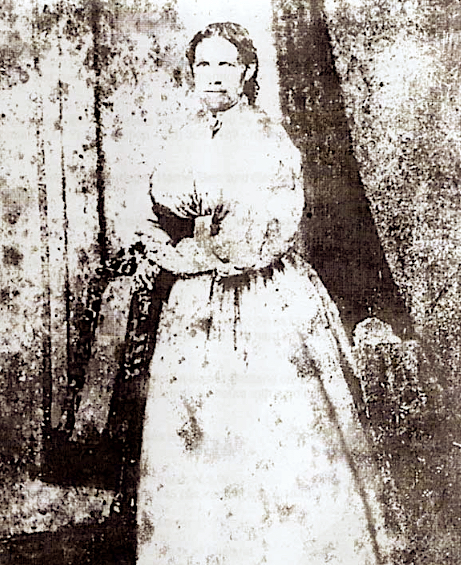
Mary Ann Bugg fought with Captain Thunderbolt (Ward), the “gentleman bushranger”. In 1865, while on the hunt for Ward, police encountered a pregnant Mary Ann instead. The Maitland Mercury reported how she “sprung up like a tigress upon one of the police … taunting him”. Upon her arrest Mary Ann faked labour contractions and when left at the station by her arresting officers, escaped with Ward. The following year she was arrested for vagrancy; in court, Senior Sergeant Kerrigan listed one of her major crimes as dressing in men’s pants.
In 1867, after Mary Ann’s third and final arrest for stealing twelve yards of fabric, she wrote her own petition to Governor Sir John Young explaining her unlawful imprisonment. Her statement caused public support to stream in and forced the inspector-general to find her “wrongfully convicted”.
Mary Cockerill (Mouheneener) 1799 – 1819
Born in 1798 or 1799, Mary was a Tasmanian Aboriginal woman most likely of the mouheneener people of nipalunaa (Hobart). All records related to Mary only provide her English name, given to her by the colonial Cockerill family with whom she lived and worked as a young teenager.
While staying with the colonists, Mary maintained close ties with her traditional culture and community. She was depicted by her contemporaries as articulate, brave, and resolute. She wore clothes that mixed items from the two cultures, described as “neither Native nor European, but a very pretty sort of costume made of skins, feathers and white calico.”
Mary was crucial to the success of a group of bushrangers, the Whitehead Gang, using her bush skills to steer the group through the VDL landscape and helped them evade capture. After being shot by the group’s leader Mary Cockerill helped track him down.
Mary received a full pardon and was sent to Sydney. However Mary contracted a pulmonary disease and returned to Hobart town where she died in June 1819, barely twenty years old. Mary is buried in St David’s Cemetery, Hobart. (from various sources).
Oodgeroo (Noonuccal) (1920–1993)
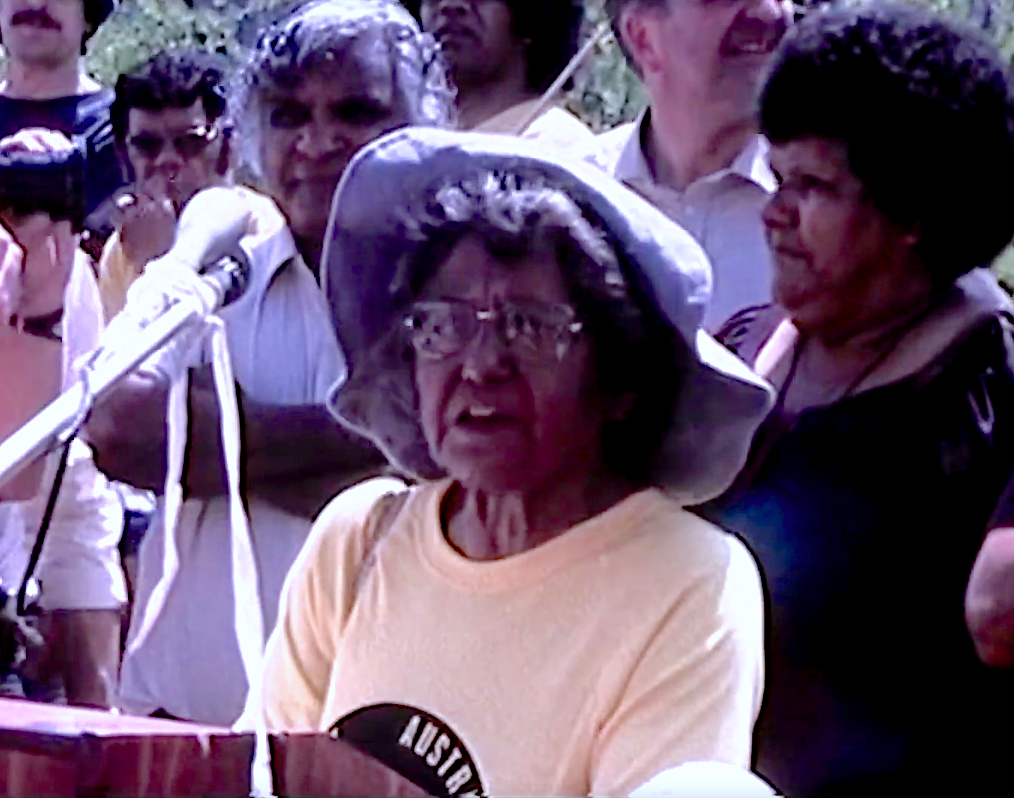
Oodgeroo speaking at a 1982 Land Rights Rally prior to the Commonwealth Games
Oodgeroo was born in 1920 on Minjerribah – one of six children. Their father, Ted Ruska, was a labourer active in workers’ strikes. She left school at 13, in 1933, to worked as a domestic for Sir Raphael Cilento. During World War II, with two of her brothers imprisoned in Singapore, she volunteered as a communications worker. During the war, too, she married Bruce Walker, but the marriage didn’t last.
I first met Oodgeroo near One Mile on Minjerribah (Straddie) in the early 1970s where she was conducting classes about aboriginal culture and hunting. She is one of Australia’s best poets.
Lay down the woomera,
Lay down the waddy.
Now we got atom-bomb,
End everybody. – Auntie Kath Walker (Oodgeroo), No More Boomerang
Oodgeroo worked as a servant for Sir Raphael and Lady Phyllis Cilento. Raphael Cilento was a member of the racist Australian League of Rights. Oodgeroo had a son Vivian while under his roof.
Oodgeroo was a member of the Communist Party of Australia and was instrumental in the success of the 1967 referendum. Oodgeroo was a victim of the hijacking of a plane by the Palestinian Liberation Organisation who held guns to a passenger’s head on a runway in Tunisia. In the belly of that aeroplane, Oodgeroo pleaded for the life of a German businessman. He was shot but Oodgeroo was allowed to leave the plane.
Her oldest son Dennis ((Bejam) carried on his mothers work as a warrior. Dennis and Sam Watson set up a chapter of the Black Panther Party in Meanjin (Brisbane) in the early 1970s.
Ian Curr
3 Feb 2023
Thank you for telling me about Tarenorerer, I did not know.
I was aware of Mary Bugg but I think Aboriginal people in bushranger gangs were just surviving by any means necessary given the circumstances, not waging war against the British as Pemulwuy, Dundalee and the Kalkadoons did.. None of the Bushrangers could have survived without Aboriginal support and the Aboriginal people were protected by the gang. I have not heard of Mary Cockerill before but on what you wrote I would say the same thing.
Trugganinni was a victim and hero of war but she did not fight, she was a peacemaker, negotiator and compromiser. I mean no disrespect in saying that, she saved more lives than the warriors did. Same with Oodgeroo, she opposed the militancy of the Black Panthers in favour of negotiation and compromise as symbolized by her work for the 1967 referendum and participation in Expo 88. Bejam did not so much continue his mother’s work because she opposed him in much of it, but in her old age her path and Bejam’s path became one, rooted in Moongalba when the two of them (illegally) buried Vivien there. From that funeral grew Noonuccal Kunjeil and the new Straddie dances, the “Incarcerated Peoples Cultural Heritage Aboriginal Corporation” (IPCHAC) and the “Oodgeroo of the tribe Noonucal Custodian of the Land Minjerribah Sacred Treaty Circles” . I lived at Moongalba a couple of times and looked after Oodgeroo for a few months when Bejam was in gaol. The two of them were a dialectical force, the intense conflict between the two was held together by an underlying law respect that brought into being a sum greater than its parts and deep enough to pass both Oodgeroos and Bejam’s strict but different standards.
I think it is not helpful to conflate warriors of armed resistance with community leadership or political militants as the present sovereignty movement does. Athough a warrior spirit runs through all the modes of war, negotiation and political activism they are three very different things One reason to differentiate between military war and militant political negotiation is the military war was defeated. The opportunity for military victory has passed, there are just too many British with guns now. In the absence of an armed wing, all the movement has is negotiation and politics and that requires a matrix of understandings and temperaments very different to armed conflict.
I witnessed a fascinating conversation once between Bejam and other people who are still alive so I won’t incriminate them by naming them. It was a very serious but hypothetical discussion about how to kill every non-Aboriginal person in Australia, a question that Pemulwuy and Dundalee would have considered in their times. Various methods and their logistical viability were discussed and weighed against each other but in each case there was a fundamental problem – how to stop Aboriginal people being killed in the process. For example, if the dams were poisoned or blown up then what would Aboriginal people drink? The conclusion of the conversation, that I suspect Bejam was provoking from the beginning, was that there was no viable para-military option. The only option is negotiation – treaty. This did not exclude organized violence such as the Boggo Rd riots or burning down the Palm Island police station, but to use this violence to strengthen the political/ negotiation. I think this is where Oodgeroo’s and Bejam’s trajectories came together.
I think we should look beyond the five years Mary Ann Bugg spent as Thunderbolt’s “chief lieutenant and right-hand man”. Hers is a story of perseverance, ingenuity, and survival during a time when society and the justice system were far from kind towards Aboriginal women and outlaws – let alone a person who was both.
__oOo__
You raise the question of violence. Yuggera elder, Kevin Vieritz, signed a statement, reflecting a ‘treaty’ of sorts with members of the Brisbane Sovereign Tent embassy. Kevin Vieritz who was a Jagera man of the Carter – Bonner families. One of Kevin Vieritz’s uncles, Neville Bonner, was the first aboriginal man elected to represent Queensland in the Australian Senate. The embers of the fire had been transported to Musgrave Park from the original tent embassy outside the old parliament house in Canberra. The Aboriginal Tent embassy was set up in 1972.
Kevin’s ‘treaty’ was signed and witnessed during violent attacks made on the Aboriginal Sovereign embassy in Musgrave Park in 2011-12 by the LNP government and Brisbane City Council. There were over 50 arrests of aboriginal people and their supporters during this conflict. It was the result of yarning and negotiation between us and was signed by Kevin and witnessed by a CPA, Katherine Hunt. It reflected an agreement that we would defend the ‘sacred fire’ at the embassy at all costs.
Let me make it clear that we did not start this fight. It began: “On the 11th of December 2012 (when) the Brisbane City Council removed all of the physical structures of the Brisbane Aboriginal Sovereign Embassy. They then doused the sacred fire despite making agreements and publicly stating that they would not do this. That night the sacred fire was re-lit and in response the council sent in approximately 10 members of their emergency response team, 60 police officers and a fire crew. Three (3) people were arrested defending the fire: Wayne Wharton, Boe Spearim and Hamish Chitts.” – report by podcaster, Corey Green, on Apple Corey.
However Kevin Vieritz was determined to defend the sacred fire. As a traditional owner Kevin had made: “welcome people from the tent embassy who conduct meetings on my land. When BCC officers and police come uninvited I regard that as being trespass on Jagera land.” – Statement of Kevin Vieritz (Jagera traditional owner) regarding maintaining the sacred fire on the Deed-of-Grant-in-Trust lease at Musgrave Park.
It required quite a lot of ingenuity on his behalf part. I do not wish to overstate my role in it. I chopped wood for two (2) years, bringing it to Jagera Hall and stashing the wood in the surrounds. This was to maintain the sacred fire. Our actions and the actions of those who brought this on ended in conflict with the BCC Rapid Response teams and police armed with tasers (and willing to use them, which they did on one occasion, pointing it at an elder).
Kevin’s signed statement and agreement with me was not widely known. We did not mention what our intentions were (or the existence of the agreement) when the matter went to trial (however Kevin did tell the court that he had instructed me to light and maintain the fire because he was prevented from doing so under the Bail Act of Qld. As a result on his action, this Jagera elder was arrested on multiple occasions and I was placed on five (5) charges of lighting and maintaining the sacred fire in a public park.
Here is a short video of some of the confrontations that our actions provoked (Kevin and I stand side by side throughout these confrontations.
In the end it was resolved in a court case where the magistrate asked the BCC lawyer if Lord Mayor Quirk considered himself to be above the law.
Not long after this conflict, Uncle Kevin passed away. The State Library of Qld put a huge poster of this Yuggera elder up on the front of their building. Management did not give or seek his name nor did they keep any record of it, they did not seek permission for his image to be placed on the library wall in the way it was and they never acknowledged the role he played in making the Sovereign Tent Embassy and sacred fire a permanent fixture in Musgrave Park over 10 years later.
I wrote to the State Library about their omissions but they did not reply to my substantive query nor did they rectify their disrespect. Kevin received more respect from the magistrate he appeared before. The magistrate ruled:
“There was evidence from Mr. Vieritz which I accept that the fire which he asked Mr Curr to light and maintain was a sacred fire in the culture of his people. Mr Vieritz explained that there are two types of fires. One is a communal fire and has significance for the family and community and the other type of fire is the sacred fire around which the truth is to be spoken. It is a place for seeking help and is a place where new ideas are born.” – Magistrate Chris Callaghan in BCC vs Curr
Ian Curr
3 Feb 2023
Kevin was a committee member of the above mentioned IPCHAC when I worked for it. I used to chauffeur him and the other committee members on day release from Boggo Rd and Borallon.
You’re a bush lawyer, you might appreciate this – IPCHAC was an Aboriginal corporation registered under federal Aboriginal corporation legislation, with its committee and membership consisting entirely of prisoners. It was incorporated 1988 soon after the Boggo Rd riots.. The IPCHAC corporation auspiced the Boggo Rd lifers’ organization – the Queensland Indeterminant Prisoners Association (QISPA). When the screws tried to prevent IPCHAC and QISPA from having meetings, their lawyers took action based on section 109 of the Australian constitution – if there is a discrepancy between commonwealth and state law then the commonwealth law prevails. As such the screws and their authority under state legislation could not prevent the federal corporation – IPCHAC and QISPA from fulfilling its obligation under commonwealth law to have regular executive and general meetings. At first the committee used to meet in Boggo Rd and the screws had to let committee members attend even if they were in lock-up. Once IPCHAC got an office in Ryan St West End (1990?) the committee meetings – three times a week – were held at the IPCHAC office and the screws had to allow day release for the committee members to attend. Bejam was the legal mastermind behind all that.
You state:“section 109 of the Australian constitution – if there is a discrepancy between commonwealth and state law then the commonwealth law prevails”.
Well yes, but there are exceptions to that rule. For example Native title does not override state law [See http://classic.austlii.edu.au/au/journals/FedLawRw/2010/19.pdf%5D
Denis (Bejam) Walker (Noonuccal) was extradited from NSW to Queensland to face criminal charges here. He argued in the High Court that neither the state nor commonwealth laws permitted an aboriginal man to be extradited from one aboriginal nation (Bundjalung) to another (Noonuccal). He relied in part on Blackstone’s judgment in the High Court that “colonists carry with them only so much of the English law, as is applicable to their own situation and the condition of an infant colony”.
Bejam argued that neither State nor Commonwealth Law applied to a Noonuccal man. This is patently incorrect in law.
The High Court ruled that: “It is a basic principle that all people should stand equal before the law. A construction which results in different criminal sanctions applying to different persons for the same conduct offends that basic principle.” (See Racial Discrimination Act 1975 (Cth), s.10).
I am not saying the High Court is right because many people including Noonuccal people do not stand equal before the law. For example in 1978 over a 1,000 people marched from NSW to the Queensland border. We we crossed the border many of us were arrested because democratic rights that prevailed elsewhere in Australia did not apply here in Queensland. Eventually, this was corrected under the Peaceful Assembly Act 1992 of Queensland after the National Party government was defeated.
All I am saying is that neither State nor Commonwealth Law recognise aboriginal sovereignty.
Uncle Kevin (a traditional owner of the land in and around Musgrave Park) wanted me to help him get before the courts so that he could argue for sovereignty. He came up with a plan of how to do that and we executed that plan together so that the Brisbane City Council and its lawyers were forced into a situation where they had to argue that the section of land around Jagera Arts was not ‘for an aboriginal purpose and no other’ as stated in the 1999 Deed-of-Grant-in-Trust (DOGIT) that covers that area of ground .
Council wished to mediate, but we would have no part of that.
Kevin wanted his day in court and I was a means to that end. When we got to court Kevin and Sam (both from Yuggera nation) gave evidence that had not been permitted or accepted in Queensland courts before.
Nevertheless Kevin was still angry, upset and frustrated because the court would not rule that aboriginal sovereignty prevailed quoting Walker v NSW as part of its reason for the decision.
Ian Curr
4 Feb 2023
I differ from Howard, Brough and Price in that I laud the staunch support the women of Ireland gave to the republic.
Feminist historians have pointed out that the role of women in the rebellion has been airbrushed from history. They cite the example that the note of surrender was carried by a woman, Nurse Elizabeth O’Farrell, through streets heavy with sniper fire. Her comrades were fearful that she would be shot down, but she survived. In Neil Jordan’s film on Michael Collins her role is assigned to a man.
The facts are that the uprising was the very first of its kind to offer an equal role to women. All of the leaders, with the exception of De Valera, believed that women should take part in the fighting. There were between 650 and 1700 women in Cumann na Mban, the women’s para military organization, in 1916. By 1921 that number had risen to 21,000.
Just look at the role of eight of the women who took part in the Easter uprising.
The Countess Markievicz (1868 -1927)
Pride of place goes to Countess Markiewicz feminist and socialist and a true revolutionary. Born into the Anglo-Irish aristocracy, “Countess Markievicz was the only woman sentenced to death for her role in the Rising. Her sentence was later commuted to life in prison because of her gender and she was ultimately released in an amnesty in 1917.
In 1918 she was the first woman elected to the British Parliament, but refused to take her seat; instead she became the only woman to hold a cabinet position, as Minister of Labor, in the first Irish Assembly. The countess died, virtually penniless, in 1927.
Kathleen Lynn (1874 – 1955)
Kathleen Lynn, a doctor, gave medical training to recruits to the Irish Citizen Army, a paramilitary organization, and allowed her home to be used as a munitions store. She served as the Chief Medical Officer during the Rising, famously describing herself as “a Red Cross doctor and a belligerent” when arrested
Winifred Carney (1887- 1943)
Armed with a typewriter and a Webley revolver, Ms. Carney was aide-de-camp to James Connolly, a socialist leader, in the rebellion’s headquarters in the General Post Office.
When Connolly was wounded in action (he would later be carried to his execution on a stretcher), Ms. Carney ignored orders to evacuate and stayed with him until after the surrender.
Margaret Skinnider (1892 – 1971)
Scottish schoolteacher Margaret Skinnider quit her job in the spring of 1916 to take part in the rebellion. (On an earlier trip to Ireland, in 1915, she reportedly smuggled detonators under her hat.)
During the Rising Ms. Skinnider, a member of a shooting club in Scotland, served as a sniper — in the same garrison as the Countess Markievicz — and was shot three times. When she recovered she returned to work as a teacher and campaigner for women’s rights. She is buried in Dublin next to Countess Markievicz.
Despite De Valera’s patriarchal tendencies, those women still fought. Karma will take that into account and not judge the movement by De Valera’s conduct alone.
The war of independence was a grass roots guerilla campaign. Just like in Vietnam there was no clear distinction between combatant and civilian. The IRA command structure extended into families, churches and workplaces not just the brigades. Although the community existed in a Roman religious patriarchal hegemony, the community as a whole, men and women, rose against the British. (and then they turned on each other but that is another story).
The extinguishing of women from history is not unique to the Irish story. We know about Pemulwuy and Dundalee etc, but how many stories of women warriors are there?
The political economy of sheep, as probably envisioned by Joseph Banks when he sent Merinos from the King’s flock to Australia –
As mentioned above, the capitalist engine of the Australian sheep industry was British textile factories – that is where the money was made. Colonists made money by shipping wool to the British factories. It was not necessary to own land to send wool to Britain, you only had to own the sheep. Squatting was the ideal business model as it required no investment in land so much less start up capital was necessary – just enough to buy the sheep and feed the convicts and blacks until the wool was sold. Furthermore, if the venture collapses no land capital is lost, there is no land to lose so there was less risk in investments, investment loans under fractional reserve banking is money pulled from the bank’s arse so not even the bank loses. Once the squatters were put into their place and had to invest in land, the bank gave them investment loans to do so. This drove the colonization of Australia from the mid 1830s, when fractional reserve banking was introduced, until the twentieth century. The process was supercharged during the gold rush when banks’ gold reserves increased and therefore their capacity to increase tenfold the “value” of the gold in credit and bank notes, and then the gold standard was globalized, further increasing the “value” of the gold.
It is my opinion that the Shearers strikes were defeated by fractional reserve banking, not the police, scabs or the ALP. The graziers could get infinite finance to hold out during the strikes. The introduction of shearing machines was imminent and investment in them was the future of the wool industry. Even the strikers burning the shearing sheds had no significant impact on the graziers because they all had to build new sheds in the near future to accommodate the shearing machines, and there was infinite bank credit to do so.
Edward Curr was from Lancashire and he knew only too well that VDL wool was destined for those dark Satanic mills. His father John Curr was steward to the Duke of Norfolk in Sheffield. John Curr was the engineer who replaced wooden rails with iron in the Duke’s mines.
My brother John agrees with you Edward Curr was a capitalist out for the main prize, money. Personally I think there is more to it than that but Edward (Snr) certainly was trying to enrich his family. As for connections with the Port Philip Association I can’t help you there but I’m sure there must be some link. I did look at the family tree but could find no hint of an association with Batman, Mercer and Co. According to my brother John, Edward Curr was definitely part of a group and he did send his son Edward to Port Phillip district prior to his departure from the VDL company adventure in 1841.
Ironically, it was the intransigence of the crown that forced Edward Curr to become a squatter.
Ian Curr
31 Jan 2023
Thanks for the conversation Ian, I have learned a lot. I had a generalized and euro-centric understanding of banking in the industrial revolution and I knew a few things about pastoralists in NWQld from researching my Waltzing Matilda play but the VDL invasion of NSW joins a lot of historical dots for me.
Thank you for sharing the story of your ancestors. I am the first in my family to be born in Australia, my parents were ten pound poms. However I have some very bad ancestral karma in South Africa, India and Northern Ireland but unfortunately none of my relatives wrote books about it. My grandfather was an officer in the tank corps and my mother was born in Karachi (she had to prove she was white when she came to Australia). My grandmother never talked about it except letting it slip that she had black servants but the tank corps played a brutal role in suppressing Indian independence protests. However about the same time my great uncles on my father’s side were in the IRA so that soothes my karma a little bit.
Anyway, I have to redirect my mind back to preparing my appeal now, which is due to be heard in June.
JT
John,
I am not in the school that says Hobart town and Port Jackson were a rum economy in the early days of colonialism. The much lauded economist, R. M. Hartwell, did not include the period before 1820 in his account of “The economic development of Van Dieman’s Land”; before this, he reasoned, the colony was merely a prison farm on a subsistence basis.” Lloyd Robson similarly dismissed early Van Dieman’s Land as “a rum economy”.
No, that is not what was happening. The early pastoral economy in the VDL colony took the island backwards because of the ecological disaster that it created. I saw evidence of this when I first visited the island in 1971. I can see how many years later Bob Brown and his crew were so unhappy about what was going on in the former VDL.
British colonial ignorance destroyed a thousand years of land management in the space of fifty (50) years. Even before the island was proclaimed Tasmania, settlers had made the native emu and forester kangaroo extinct. Not to mention the killing of native birds, marsupials, rosellas, eagles, devils and thylacines. Sometimes, as Louisa Meredith observed, their destruction was done on the basis of nothing more than prejudice. Over grazing depleted native perennial and annual grasses and introduced weeds which soon compacted and eroded the soil. Scotch thistle was a plague on the land along with blackberry, docks and sorell. Rabbits and feral cats multiplied and the introduction of the English hunting dog reeked havoc among the emus and local kangaroos who had no natural enemies because the devils and tigers jaws weren’t strong enough. [from James Boyce in Van Diemen’s Land].
But this destructive pastoral economy was weak right up until 1830. The Crown who promoted the island with fabricated accounts of what was to be made by merchants through export of wool and mutton. This was fanciful.
The early economy was based on kangaroo and fishing economy. This did not require a lot of capital. The sealing industry was done in co-operation with aboriginal women who possessed the knowledge of how to hunt seal. Sealers provided the boats (often constructed in Port Jackson).
The cattle and sheep economy gradually became stronger but this resulted in the destruction of magnificent grasslands in the southern and central parts of Van Diemen’s Land. These grasslands cultivated by aboriginal people over thousands of years soon reverted to forest and weeds once the British took over. This was often lamented by the early settlers including Edward Curr Snr, who had this to say about the speedy transition to a pastoral economy:
“it was really astonishing how fast the latter [sheep] increase: you may calculate on five young lambs in two years from one ewe.”
Curr observed that a single shepherd could supervise over 1000 animals.
” Given this it was not surprising that many older colonists remained loyal to the traditional breeds long after the wool trade was developed and your newer breeds were introduced. The land commissioners observed in May 1828 that the lower order of settler consider the merinos as a curse to the colony, that they are eternally scabby, require much attention, and that they diminish in size. They therefore keep up the blood of the Bengal and Tesswater sheep.” – Excerpt from Van Diemen’s Land by James Boyce p68
What people don’t understand is that Van Demons land was a backwater that London had little interest in. The financial centre of Empire could not care less about the devastation and destruction that was being visited upon one of the most beautiful places I have ever seen.
When I was old enough I hitchhiked from Meanjin/Brisbane down to Tasmania. I wanted to see where my forebears landed in Australia. I got my mother to take me out to Ipswich and I hitchhiked all the way to Port Arthur.
In Tasmania I slept in freezing stony creek beds, I climbed the famous Nut near Stanley and spent the night in the long grass. I walked over Cradle Mountain and around the banks of Lake St Clair. I hitchhiked down to Port Arthur and inspected the in human conditions that convicts experienced in the early days. I slept in a park only to be harassed by AJ’s [Army Jerks] throughout the night. It was no surprise to me when the port Arthur massacre occurred many years later. I put it down to the mentality that I experience that night.
I am telling you this because I’m not coming to the question of early colonisation from an intellectual standpoint.
I’m coming at it from my own experience and that of my ancestors. It is hard to listen to bullshit. People here like to think of colonial Australia as being some great place … you often hear them say it; but, as far as the northern hemisphere is concerned, we just don’t count, we are irrelevant.
I have never been anywhere as a tourist … I haven’t actually been anywhere much but I have walked in all over the former colonies of Moreton Bay, Port Jackson and Van Dieman’s land. These walks have informed me of the importance of country, something that has barely crossed the feeble brains of bankers and the like.
Ian Curr
30 Jan 2023
Reference
Van Dieman’s Land by James Boyce (2020).
Van Dieman’s Land by Edward Curr (1824).
The only significance of VDL at that time was the VDL Company, the Bank of VDL and the Derwent Bank and their role in colonising the mainland. The VDL Company land grant in Circular Head was useless, which is why investors were told not to invest in it and instead turn their attention to the mainland – to the schemes of Batman, Edward Curr Sr and others who each squatted multiple runs on prime land.
Seen this? https://eprints.utas.edu.au/220/
John,
I was once told by a patronising Englishman that the trouble with Australia is that it has too much geography and not enough history … clearly the observation is not really relevant to Tasmania … it has a remarkably rich tradition of historical literature. – Henry Reynolds in his Introduction to Grease and Ochre by Patsy Cameron.
My brother John Curr, wrote this about McFarlane’s thesis in August 2021:
“I understand and agree with emphasis placed on the dispossession and nearly successful genocide being unlawful and that it was achieved by Lt Gov Arthur’s fraud. The fraud went in two directions, to his superiors the British Colonial office and, through his agent, the despicable, opportunist, hypocrite, James Augustus Robinson, to the Aborigines. My understanding of the crime perpetrated on the Aborigines of Van Diemen’s land was best communicated to me on a visceral level in the excerpt from Aboriginal Society in North West Tasmania: Dispossession and Genocide by Ian McFarlane B.A. (Hons).
“The Tamar set sail for Flinders Island on the 1 October 1835. For Pevay and most of the Friendly Mission Aborigines on board, this was the last time they would set foot on their homeland. Pevay’s brother Penderoin died while they were in Hobart leaving eight adult Aborigines to make the journey. Mannalargenna seemed acutely aware of the significance of this voyage, no doubt realising that Robinson’s earlier assurances that he would be allowed to remain in his traditional lands were now worthless. On the 8th October as the vessel passed Swan Island, Robinson’s journal described Mannalargenna’s grief and pain as he bade farewell to his country …
When we were off Swan Island Mannalargenna the chief gave evident signs of strong emotion. Here opposite to this island was his country; Swan Island was the place I brought him to when I removed him from his country. He paced the deck, looked on all the surrounding objects, fresh recollections came to his mind. He paced to and fro like a man of consequence, like an emperor. Round his head he had tied a slip of kangaroo skin, which added greatly to his imperial dignity. At one time he took the map in his hand and looked on it intently, took the spyglass and looked through it. It was amusing enough to see him. He allowed that I was equally great with himself, that I had travelled in all directions” – James Augustus Robinson.”
McFarlane’s paper is yet another example of the truth of what many have been saying for as long as I can remember (since the 1970s and before that, all the way back to 1835 when Curr wrote of his crimes against humanity. Truth is the VDL company directors and the colonial office in London were indifferent to these truths). I am grateful to Rachael Perkins for having the persistence and courage to put on The Australian Wars which was an accurate account of what happened in Van Diemen’s Land (see episode 2 shown on NITV).
I am indebted to the makers of this series for shedding light on this terrible history. Without knowledge and recognition of the Australian Wars we can’t move forward.
Fortunately my family are an understanding mob and have, over the years, come to similar conclusions to those of Rachael Perkins. Back in the day, the Democratic Rights movement helped organise for Rachael’s old man to come and march with us against Bjelke-Petersen. Charlie gave a stirring speech before the march and left early when so many of us got arrested. I think his early departure was down to kidney failure. Poor fella was on dialysis.
So I am not alone in thinking that terra nullius was totally irrelevant to events that transpired in the colonies from 1788 till 1835 (at least).
The VDL company directors were in no doubt that they were overseeing a war conducted by Curr and his antecedents with the people of the North-West. Curr did not arrive at Circular Head to manage the VDL until 1826.Much of the killing of aboriginal people had already been done by 1826. Edward Curr impressed on the VDL board the facts of the war on the ground time and again in letters and possibly in person.
Here is but one such dispatch sent by Curr to the VDL Company directors: “Now I have no doubt whatever that our men were fully impressed with the idea that the natives were there only for the purpose of surrounding and attacking them, and with that idea it would be madness for them to wait until the natives shewed their designs by making it too late for one man to escape. I considered these things at the time for I had thought of investigating the case (the massacre at Cape Grimm), but I saw first that there was a strong presumption that our men were right, second if wrong it was impossible to convict them, and thirdly that the mere enquiry would induce every man to leave Cape Grim.” [See Inward Dispatch No.1. Edward Curr to Directors. 2 January 1828. AOT VDL 5/1.}
Edward Curr later wrote explicitly to the VDL company’s directors in London about his role in the genocide: “My whole and sole object was to kill them (the tribes), and this because my full conviction was and is that the laws of nature and of God and of this country all conspired to render this my duty … It would’ve been good, it would’ve alarmed the natives … prevented them from attempting our huts again, made them keep aloof, given them a lesson they would have long remembered … As to my expression of wish to have three of their heads to put on the ridge of the hut, I shall only say that I think it certainly would have the effect of the tearing some of their comrades, of making the death of their companions live in their recollections, and so extend the advantage the example made of them. ”
The difference between Curr and the VDL Company Directors was that he committed his intentions to paper. But the directors were thoroughly appraised of what was going on under their mandate to Edward Charles Curr (their agent in Van Diemen’s Land).
As for Arthur and Robinson, they were liars, scoundrels and murderers, both of them. There was no excuse for Robinson’s subterfuge. His intention was to put an end to aboriginal resistance and he was under orders from Arthur to do so.
George Robinson inducing aboriginal people to leave country and to lose their culture (note the shell necklace being held out by the person on the far right of this painting)
My brother John Curr (a retired lawyer) wrote this: “I see Robinson as a “Lawrence of Arabia” character in that he establishes relationships and uses them to betray people. His feigned concern for the aborigines was to establish and maintain his position with Arthur and the Colonial Office whose feigned concern never confronted the central truth that the invasion was unlawful, under international law (at the time), British law and Aboriginal law. The consequent theft of land and destruction of culture were always going to result in justified resistance. The illegality was papered over by the bare-faced and outrageous lie which became known as Terra Nullius. The consequences persist to today. ”
Remember I told you that Edward Curr refused to take the oath when appointed to the legislative assembly by the governor in Hobart town. Why do you think that was? There is a research project for you. The answer may surprise you.
For readers who are interested in the relationship between aboriginal tribes and the sealers I refer you to a book Grease and Ochre by Patsy Cameron herself a descendent of aboriginal women who participated in the economy of sealing both before and after contact with Straitsmen as they were known then.
Ian Curr
30 Jan 2023
Fact check – Edward Curr (Snr) did not leave Circular Head in VDL until 1842, seven (7) years after John Batman and the other squatters set out to cash in on the Kulin Nation land available around Port Phillip district. Edward Curr (Snr) did send his eldest son Edward M Curr up onto Yorta Yorta country near Echua earlier which became the subject of the celebrated memoir Recollections of Squatting in Victoria by that son. That son, Edward M Curr, was not a squatter by choice, he later became a public servant, the chief inspector of stock in Victoria. I suspect the young Edward was not as interested in making money as his father.
As for the claim that the VDL company ‘land grant in Circular Head was useless‘ and that Curr decamped to go to Port Phillip district at the same time as Batman & Co circa 1835, bah humbug!
The VDL company has remained a prosperous company to this day. Last time I looked the VDL company was owned by a Chinese billionaire, Lu Xianfeng, who purchased it for A$280 million. The oligarch sold part of it to a private equity firm in Melbourne for $62M and another part to a pastoral company for another $A120 million. It trades under a different name. As you can imagine the VDL Company is quite unpopular to workers and small farmers in that part of the world.
You see, Edward Curr was not worth tuppence in comparison to the real capitalists.
1/ According to the following link –
“After Curr was convinced that Hampshire Hills was more picturesque than practical and Surrey Hills was not even ‘second rate’ sheep pasture, Circular Head was developed as the principal establishment.”
“Although imported stock bloodlines were a success, the prime purpose, wool production, was a failure. Thousands of sheep were lost during 1831–33, and revenue from wool sales realised just £20 000 from 1829 to 1852. The Company turned to cutting expenditure and seeking profit from land.”
https://www.utas.edu.au/library/companion_to_tasmanian_history/V/VDL%20Co.htm
The money was in wool on the mainland. Follow the money, Curr and Batman did.
2/ Curr refused to take the oath because he was a Catholic.
“Curr refused to take the oath because he was a Catholic.”
But do you know why this was an impediment to becoming an august member of the establishment in Hobart town in the 1820s?
Why was Curr at such odds with governor Arthur?
Could it be that Curr’s allegiance to Rome placed him in opposition to the Crown?
HINT: My grandfather, Fred Curr (1865-1953), made his homage to the St. Peter’s Basilica in Vatican city, not to Westminster in London!
What were Edward Curr’s first words in his book Van Diemen’s Land? He quotes Virgil in Latin:
“… quas vento accesserit oras; qui teneant, nam inculta videt, hominesne, feraene, quaerere constituit, sociisque exacta referre”
“to seek out what regions he has reached by the wind, to seek out who occupies the land (for he sees it is uncultivated), whether humans or wild beasts, and to report his discoveries to his companions.” – Virgil in the Aeneid.
Like most Catholics he distrusted the kings of England after Henry VIII divorced and murdered his wives and after the third in line to the throne, Elizabeth I (a Tudor) had her half sister Mary executed.
1/ “Time would show that in all of the North West there was not enough land for a sheep venture of the desired size, unless you could first remove the standing and fallen timber, and that would take a generation or more; time and money which even the VDL Company didn’ t have. Backhouse and Walker concluded that the North West was not suited to sheep, being much more humid than the eastern side of the island, and the interior being cold even in summer. ‘There was little open land accessible for anything but driven Cattle, except some small places near the Coast. “
Page 7 – https://eprints.utas.edu.au/19850/7/whole_Dean_thesis.pdf
2/ Are you suggesting Edward Sr was a republican or French sympathizer? The Crown was obviously not concerned as they admitted him to parliament anyway. I have done some bloody thinking and this is what I speculate – as a Catholic he had no loyalty or respect for the King’s authority in Sydney however as well as being a Catholic he was a capitalist and had a vision of a free-market independently financed power bloc to rival the military state in Sydney. The VDL Co was sabotaged by Sydney from the beginning, promising a grant of productive land on which investments were made but the land turned out to be largely useless with the VDL Co’s main enterprise being timber cutting by convict labour, not sheep which was the company’s purpose. However as the manager of the company and as the local magistrate Curr was the ultimate authority in NW Tasmania, a long way from colonial control. As such he pioneered for-profit prisons which gave him the bulk of his workforce, which caused some concerns for the Sydney authorities (as well of course as the black war). As VDL Co manager Curr stood up to the Sydney powers, which is why the VDL board sacked him. As a politician and a squatter on the mainland he campaigned for separation from NSW and the continuation of convict labour, continuing his and the Melbourne squatocracy’s attempt to establish a free market independent from the control of the Sydney military state. I suspect his refusal to take the oath was more a refusal to come under the authority of the King’s representative in Sydney than about loyalty to Rome.
Context of Edward Sr’s refusal to take the oath – the Roman Catholic Relief Act 1828, which allowed Catholics to sit in Westminster without renouncing their religion. He was just keeping up with the times and his refusal set precedent here. I don’t think there is too much to be read into it.
This is how my grandfather Fred Curr described what happened in his memoir The Curr Family in Far North Queensland 1862-1913:
“As a Catholic, Mr. Curr refused to take the oath repudiating the doctrine of transubstantiation and acknowledging the Royal supremacy in spiritual matters.
Sir George Arthur was anxious that Edward Curr should take office, and he accordingly agreed to the omission of the anti-Catholic expressions in the oath pending advice from the Imperial Government. After receipt of instruction from England Curr wrote:
“Belview”, Davey Street,
Sir,
I was yesterday favoured with Captain Montague’s letter informing me that as a member of the Legislative Council such oaths only will be tendered to me as Your Excellency anticipates I shall have no hesitation in taking. I have to express my sincere thanks to Your Excellency for the consideration you have shown me in the matter, and to assure you of my readiness at any time. Your Excellency may be pleased to appoint to make and subscribe the oaths alluded to as well as to discharge the duties of that office with the greatest assiduity and attention. I have the honour etc.
Signed: Edward Curr
April 6th, 1826.
Fact check – Edward Curr stood up to Governor Arthur as King George’s representative in Van Diemmen’s Land. Arthur was not answerable to ‘Sydney’ (as you put it). VDL was a separate colony when Arthur was making land grants in 1826. Arthur was not required to consult with the governor of NSW colony. Arthur’s mandate came direct from the British Colonial office in London and therefor the King. Read my response titled ‘Absolute Power”.
Arthur imprisoned one of the Todpuddle Martyrs on his own farm near Hobart town. Over 500 agricultural workers were transported during their uprising up in England in the 1830s. These convicted agricultural workers were in much demand in Van Diemen’s Land.
When I first went to Circular Head in the early 1970s there were sheep everywhere. The problem was never the shortage of sheep, it was always about the shortage of workers. The VDL Company main business was about land and wool. If you look at their charter the VDL’s intention was to attract tenant farmers.
Arthur gave convicts to the VDL to build infrastructure like roads, fences, bridges, buildings etc.
Ian Curr
30 Jan 2023
1/ Yes, I misunderstood the relationship between VDL and Sydney. However my point remains – VDL Co was sabotaged or misled by the crown and Old Curr stood up to the crown, which is why the board sacked him.
2/ “Nineteenth-century British businessmen were interested in developing colonial resources, and the Van Diemen’s Land Company was formed in May 1824 to ensure a cheap supply of wool for British factories.” https://www.utas.edu.au/library/companion_to_tasmanian_history/V/VDL%20Co.htm
Speaking historically materially, the capitalist engine driving the VDL Co was British textile factories. Land speculation and development in VDL was irrelevant to this. The most valuable elements were the company’s connections in shipping and supply contracts with the British factories, which Old Curr took with him to the mainland to set up his personal sheep enterprises.
My trawling has not yet found a connection between Old Curr and the Port Phillip Association, but it was the association that supercharged squatting on the mainland and Curr took advantage of the situation that Batman and others had created in the previous few years, in his personal enterprises and his political campaign for separation from NSW. Similarly I have not yet found a connection between Old Curr and Charles Swanson who as an agent of the Derwent Bank in VDL financed the mainland squatters, but I strongly suspect there was a connection.
Swanston and fractional reserve banking – “He was responsible for introducing the overdraft system into Australian banking in 1834, in which year he established the Derwent Savings Bank.”
https://chrisganly.wixsite.com/author/post/2018/01/11/some-little-known-pioneers
The problems of the Batman Treaty with the Kulin Nation then (in 1835) is the same as it is now (in 2023) nearly 200 years later … Treaty was and is still a negotiation between the capitalists and a select group of people over land owned by the crown.
What did the treaty over Perth between the capitalist state of WA do for the Noongar people? Has the incarceration rate of Noongar people fallen, are there less Noongar children being stolen, has the age of responsibility been raised, has the capitalist state closed the gap? Are there fewer Noongar people dying in custody? No.
Regardless of what Labor promises in the Voice, neither the capitalist state of Victoria nor the capitalist state of Australia has ever ceded sovereignty to aboriginal people and is not now.
Treaty under capitalism is an oxymoron.
“Fractional reserve banking in Van Diemen’s land, an 1828 perspective. (The “Scotch system” was to have more bank notes circulating than capital held in reserve) This is what enabled the Tasmanian invasion of Victoria.” – John Tracey
Absolute nonsense!
Van Diemen’s Land, named by Dutchman Abel Tasman in the 17th century, was a separate British colony with Governors wielding extraordinary power.
Governor Arthur probably had more power than any political figure in Australian history. He gave out massive land grants to members of his class and ruled the convicts with a rod of iron, establishing at Port Arthur, the most brutal gaol in the empire.
Ian Curr
29 Jan 2023
You are failing to see the significance of development loans in development. Nothing happens without finance. Even a grant of land is useless unless you can stock it. While the earliest camps may have exchanged IOUs, when the banks arrived (and there were two in Hobart in 1828) they issued bank notes as credit. This funded the squatters investments on the mainland. As fractional reserve banking, “the Scotch model”, expanded in Britain and therefore in all Australian banks the infinite credit that was available supercharged the development/invasion in the whole continent from the 1830s onward.
Governor Arthur was a bureaucrat. The real power is in the economy, it pulls the bureaucrats’ strings. Interestingly, Old Edward Curr tried to convince Arthur to allow the Van Diemen’s Company to expand into banking but Arthur refused, concerned for the public good and there would be too much power in the company. But within a few years the “independent” Van Diemen’s Land Bank was established. Where is the power – the governor or the money?
The Van Diemen’s Land Bank was first major bank failure of the 1890s depression in Australia. The bank lent heavily to Tasmanians who invested in silver mining ventures. When the mineral prices crashed in the 1890s, the bank was unable to survive the number of defaulting loans.
Power lay with the ruling class who set up a royal commission into the corruption that led to the bank’s failure.
In feudal times, power lay with the land, after the industrial revolution, power lay with the owners of the means of production; the real power of the banks came later but produced a number of global financial crises (1929, 1987, 2008) that have shaken capitalism to its core.
Ian Curr
5 Feb 2023
Just received this racist hate mail in my letterbox – Ian Curr, editor WBT 7Feb ’23:
“TREASON AGAINST AUSTRALIA FOR THE VATICAN
BY REFERENDUM CON JOB ABORIGINALS RECOGNIZED SEPARATELY IN THE CONSTITUTION AND/OR GIVEN A RACIAL VOICE TO PARLIAMENT.
SEPARATE ABORIGINAL NATIONS ESTABLISHED.
WITHOUT A REFERENDUM, HIGH COURT EXTENDS SEPARATE RECOGNITION TO ALL OTHER ETHNIC GROUPS, RELIGIONS AND CULTURES THROUGH ANTI-DISCRIMINATION LAWS.
SEPARATE ETHNIC NATIONS ARE SET UP.
VOTING NO TO SEPARATE RECOGNITION OF ABORIGINES AND ETHNIC GROUPS IS NOT RACIST. ABORIGINES ARE BEING USED BY “HOLIER-THAN-THOU” ELITES TO CHANGE AUSTRALIA OUT OF EXISTENCE.
NOTE: The British referred to “Australia” as Terra Nullius to reflect Aboriginal belief the Land owned Them. The assertion that it meant “Land without people” is a lie created by collusion between a priest-advocate and his father Justice Brennan, a High Court Justice involved in the Mabo decision. Land Rights are apartheid as is “First Nations”, separate indigenous flags, sporting events and Public Service Departments.
Vicarius Filli Dei=666
G Church BNE 4000 ”
See image of letter –
https://workersbushtelegraph.com.au/wp-content/uploads/2023/02/wp-1675759903342.jpg
Fractional reserve banking in Van Diemen’s land, an 1828 perspective. (The “Scotch system” was to have more bank notes circulating than capital held in reserve)
This is what enabled the Tasmanian invasion of Victoria.
“Another thing is, that the New Bank proposes, as we have been informed, to open Cash Credits upon the principle adopted by the Scotch Banks, which has raised them far above any other Banking Establishments in the United Kingdom, besides being a most extensive benefit to the Public. Should the New Bank pursue this plan, it might be highly desirable for the old one to adopt it also; as it seems quite clear that cash credits are far more beneficial and far less dangerous than extensive discounts, while at the same time the example of Scotland distinctly shews that it is by no means prejudicial to the Establishment, but quite the reverse.”
https://trove.nla.gov.au/newspaper/article/232997925
Heads up on the fact check, John.
1835 was a very big year for the capitalist state overturning the treaty proposed by Batman’s group which included squatters, aboriginal people from Van Diemen’s land and translators from nations to the north.
On 6 August 1835 Governor Bourke, on behalf of the Crown, declared the British owned the entire land of Australia, and that only it could sell or distribute land.
To quote a letter from Engels to Marx on 21 August 1852:
“California and Australia are two cases which were not provided for in the (Communist) Manifesto: creation of great new markets out of nothing, they must be put into it.”
Under the capitalis state, land prices around Port Phillip were set by auction, but only the rich could afford to buy!
Ian Curr
28 Jan 2023
So was Marx right, that rapid capitalist expansion in California and Australia was inevitable and necessary for the emergence of the working class and the next step towards socialism?
I reckon Marx’ basic economic flaw is the lack of weight he gives to banking, perceiving banks to be containers of accumulated capital rather than as generators of new money, pulling it out of their arses through fractional reserve banking whereby customer deposits can be multiplied infinitely as debt. Fractional reserve banking was just taking off in Europe in Marx’s times and he missed the significance of it. It is bank debt, not accumulated capital, that drove capitalist expansion from the middle of the nineteenth century until today. This is what the Melbourne Club Squatters figured out, that they could get infinite finances to expand their enterprises from European banks. European Banks with offices mainly in Melbourne sent travelling salesmen to squatters across the nations offering credit. This is how the rich could afford to buy land.
How the West was won, and the Great Southern Land too –
Fractional reserve banking is bank regulation whereby a bank must keep a percentage of its customer deposits, usually around 10%, so that customers can withdraw money when they want. The other 90% can be lent out.
A simplified hypothetical that does not take into account interest rates but it makes the point –
A worker puts their hard earned $100 into Bank A. Bank A lends $90 of it to Bank B. The worker still has $100 in the bank and Bank B has $90. So there is now $190. Economists call this the multiplier effect.
Bank B deposits its borrowed $90 into Bank A, so Bank A holds $100 again and can lend another $90 to Bank B. The worker still has $100 and Bank B now has $180 held in Bank A. This cycle of $90 loans could go on indefinitely, or –
Bank B withdraws its $180 from Bank A, drawn from the cash reserves of 18 workers. Bank B can now lend $162 to Bank A and leave $18 (10%) in reserve. Bank A deposits the money in Bank B so Bank B can lend another $162 to Bank A, so the worker still has $100 (minus bank fees) and Bank A now has $324 and can lend Bank B $291.60. Etcetera ad infinitum.
This is what Alan Bond and Christopher Scase called “leveraged debt”. Any scammer with a line of credit can get finance for the biggest of projects, its has little to do with accumulated wealth. This is what the Melbourne Club Squatters did.
Whatever it was that Cook did in the name of King George, it was the basis for King George and the parliament to set up a colony here.
Cook’s secret instructions – “You are also with the Consent of the Natives to take Possession of Convenient Situations in the Country in the Name of the King of Great Britain: Or: if you find the Country uninhabited take Possession for his Majesty by setting up Proper Marks and Inscriptions, as first discoverers and possessors.” https://www.foundingdocs.gov.au/item-did-34.html#:~:text=Cook's%20Secret%20Instructions%20represent%20Britain's,trading%20posts%20around%20the%20globe.
Terra Nullius is irrelevant, it is a retrospective legal argument to rebut claims of Aboriginal land rights and I think the term was never used in Australia until the Gove land rights claim.
The Select Committee of the House of Commons on Aborigines stated in 1837: “The land has been taken from them without the assertion of any other title than that of superior force and by the commission under which the Australian colonies are governed, Her Majesty’s Sovereignty over the whole of New South Wales is asserted without reserve. It follows that Aborigines must be considered within the allegiance of the Queen and as entitled to her protection. Whatever may have been the injustice of this encroachment, there is no reason to suppose that either justice or humanity would now be consulted by receding from it.” https://www.alrc.gov.au/publication/recognition-of-aboriginal-customary-laws-alrc-report-31/5-recognition-of-aboriginal-customary-laws-at-common-law-the-settled-colony-debate/the-settled-colony-debate/#_ftn34
Where terra nullius begins – Milirrpum v Nabalco Pty Ltd
https://en.wikipedia.org/wiki/Milirrpum_v_Nabalco_Pty_Ltd#:~:text=Milirrpum%20v%20Nabalco%20Pty%20Ltd%2C%20also%20known%20as%20the%20Gove,decided%20on%2027%20April%201971.
Now you are getting on track … terra nullius was a legal fiction invented to cover the absurd denial by colonial authorities of aboriginal customary lore over land. The first treaty with the Kulin nation was proof that, at least on the side of the Wurundjeri elders on the banks of Merri Creek, that they had control of the land and the waterways.
Treaty by Wurundjeri elders on the banks of Merri Creek with interloper John Batman and his party from Van Diemen’s Land
There is no doubt the same bullshit is still being dished up by Australian courts (See Walker vs NSW in the High Court).
But, as Sam Watson said after the trial over the sacred fire in 2014, ‘at least the judge acknowledged our customary law’.
What Callaghan SM said was: “There was evidence from Mr. Vieritz (Yuggera) which I accept that the fire which he asked Mr Curr to light and maintain was a sacred fire in the culture of his people.
Mr Vieritz explained that there are two types of fires. One is a communal fire and has significance for the family and community and the other type of fire is the sacred fire around which the truth is to be spoken. It is a place for seeking help and is a place where new ideas are born.” – Magistrate Chris Callaghan in BCC vs Curr.
Uncle Kevin Vieritz carries the sacred fire in Musgrave Park in 2014
Ian Curr
29 Jan 2023
“Whatever it was that Cook did in the name of King George, it was the basis for King George and the parliament to set up a colony here.” – John Tracey.
You are missing my point, John. The British crown did not develope colonies in Australia until much later. ‘Australia’ was already a settled country that had its own land laws held over country for millenia.
First Nations people resisted until overcome by disease, destruction of native foods and medicines, military conquest and the dreaded Native police. This military conquest took a long time to achieve as the frontier wars raged inland till the 1890s. The Kalkadoon war of resistance was not overcome till heavily armed police overcame the Kalkadoon at Battle Mountain in 1884. Their resistance severely restricted settlement.
Your so called colonial governors did not even bother to send explorers inland from Sydney Cove till 1813. When crossing the Blue Mountains, Blaxland, Lawson and Wentworth, stressed the military advantages of their discovery arguing that ‘the only parts to it, although of easy access, it’s through a country naturally so strong as to be easily defended by a few against the efforts of thousands’.
Colonialist imaginings of invasion by the French, the United States and the Russians persisted until the middle of the 19th century. The crown did not formally take colonial possession of Australasia until it signed Te Tiriti o Waitangi with the Māori people of Aotearoa (New Zealand) on February 6, 1840. It did so at the prompting of colonial authorities in New South Wales because of the persistent and paranoid fear of ‘Terre Napoleon’. The French maintained a naval base in Akaroa in Aoetearoa long after the death of Bonaparte in 1821.
Ian Curr
29 Jan 2023
I don’t understand your logic that that the first fleet was not a British colony.
Phillip’s instructions have been lost but there is a 1787 draft of the instructions approved by the King, which says –
“……With these Our Instructions you will receive Our Commission under Our Great seal constituting and appointing you to be Our Captain General and Governor in Chief of Our Territory called New South Wales extending from the Northern Cape or Extremity of the Coast called Cape York in the Latitude of Ten Degrees thirty seven Minutes south, to the Southern Extremity of the said Territory of New South Wales, or South Cape, in the Latitude of Forty three Degrees Thirty nine Minutes south, and of all the Country Inland to the Westward as far as the One hundred and Thirty fifth Degree of East Longitude, reckoning from the Meridian of Greenwich including all the Islands adjacent in the Pacific – Ocean within the Latitudes aforesaid of 10 º 37′ South, and 43º 39′ and that it is your Majesty’s pleasure we should grant him such powers as have usually been granted to the Governors of your Majesties Colonies in America…..”
https://www.migrationheritage.nsw.gov.au/exhibition/objectsthroughtime/draughtinstructions/index.html#:~:text=The%20Draught%20Instructions%20for%20Governor,issue%20regulations%20for%20the%20Colony.
Edward Charles Curr visited both Port Jackson and Hobart town in 1820. He said that Hobart town was little more than a gaol and advised prospective setters not to emigrate. He advised potential settlers there was little evidence of a rule of law, the roads were atrocious, convicts frequently escaped, both soldier and police were corrupted, bushrangers roamed the countryside. Lawlessness and chaos beset the settlement.
Declaration of Martial Law
Thomas Davey was Lt-Governor of Van Diemen’s Land from 1813 to 1817. The European colony was little more than a camp when Davey arrived, and he was the first administrator of the whole island. He was challenged by the escalation of bushranging, but his requests to Lachlan Macquarie, Governor-in-Chief at Port Jackson, for increased military protection went unanswered. As a result of the situation, and lacking a criminal court, in 1815 Davey declared martial law.
Reference
Thomas Davey
NSW had a parliament and courts by 1823. https://en.wikipedia.org/wiki/New_South_Wales_Act_1823
The NSW parliament of 1823 had no authority to make grants of land which was the source of the wealth of the colony at the time.
That power remained with the crown.
This was confirmed by Governor Bourke when he quashed John Batman’s attempt at a land grab in Port Phillip District in 1832.
Yes Van Diemen’s land was a penal settlement. Most of the Van Diemen’s Land Company’s labour were convicts. Old Edward Curr got in a bit of trouble about that. But whatever it was, Hobart had two banks by 1828.
And yes, the crown granted land and the first government’s job was only to make laws for peace welfare and good government. But don’t you think a British colonial parliament and a British colonial court might indicate a British colony?
Regarding the banking system in Van Diemen’s Land in the 1820s. This was not a sophisticated enterprise. In an article THE BANKING SYSTEM (digitised in Trove dated 1828), it states:
“Tasmania is a Colony of only twenty four years standing, a nation (if we may be allowed the expression) in embryo; therefore we must deduce all our conclusions from local circumstances, as a reference to the doctrines of political economy as applicable to great and grown up countries, except in a few self-evident instances, would rather confuse and perplex than serve to elucidate the matter.
Under these circumstances, it is probable, that some of our opinions may clash with those which are and have been generally promulgated …”
The article seems to support my case that the political economy of VDL colony was embryonic as late as 1828.
A census in 1818 showed that settlers were still heavily outnumbered by aboriginal people at least 3 to 1. Remember the Black Wars had not yet begun so the first nations people were still in control of their lands especially in the centre and in the North-East and, to some extent, in the North-West.
However I must take issue with the article and to any conclusions you may be drawing from it. Only five (5) years prior to the writing of that article, Hobart town was still very much under construction. An extensive use of paper money, that is to say IOUs were the only mean’s available to people carrying on building. This was to their advantage because the IOUs cost nothing but the paper and print. To be specific this paper money took the form of:
“No. 20 ”Hobart town, 1st of May, 1823. 6 p.
I promise to pay the bearer on demand the sum of 6 p for the value received ”amount entered”, A. B.
Signed A – – B – –”
To this was often added ‘is payable in dollars at five shillings each’.
Some, to render their notes worthless, made them payable in colonial currency, a practice which was gaining ground daily in the 1820s. No one could define the true value of colonial currency. There was a general scarcity of money which compelled the possessor of good paper to present it continually for payment, only to find it returned rapidly, and that little was gained by its issue.” from Van Diemen’s Land – Paper money – by Edward Curr, 1824.
Ian Curr
29 Jan 2023
References
Van Diemen’s Land by Edward Charles Curr. Published London 1824. This was an account of the colony of Van Dieman’s land principally designed for the use of emigrants.
It wasn’t a conflict between wealthy settlers and poor squatters. Batman was not poor (nor was Edward Curr). It was a conflict between the authority of post-Rum Corps Sydney and the Tasmanian squatters claiming the Victorian coast.
The Ceres plaque is wrong, as is the Australian Museum and others that say Bourke proclaimed terra nullius. There are many false legal myths perpetuated by historians, such as the 1967 referendum gave citizenship rights or that Aboriginal people were considered fauna and flora before 1967 or that Mabo extinguished terra nullius, all wrong.
The first act in Australia based on the legal principle of terra nullius was Cook planting a flag in the sand on Possession Island. Bourke had no reason to reassert British sovereignty sixty five years later.
Cooks journal 22 August 1770 – “……but the eastern coast from the latitude of 38 [degrees] South down to this place I am confident was never seen or visited by an European before us and notwithstand[ing] I had in the name of His Majesty taken possession of several places upon the coast, I now once more hoisted English colours and in the name of His Majesty King George the Third took possession of the whole eastern coast from the above latitude down to this place by the name of New South Wales.”
The doctrine of terra nullius was not significant to Aboriginal people, its purpose was not to extinguish Aboriginal claim to land. Its purpose was to clearly delineate what colonies belonged to which empire – and which lands are still up for grabs – terra nullius.
From 1788 till 1935 Australia was an outpost confined and concentrated in a few areas around Port Jackson and Van Diemen’s land. The workers were convicts who received minimal food and no wage. Transportation was not ended until the 1840s. It was only then that there was a rush of free settlers. Australia’s foreign policy has not changed before or after federation in 1901, it has always been designed ti keep people out.
The significance of Batman’s treaty and Bourke’s proclamation of Terra Nullius was the expansion that occurred in the years that followed. European capitalist expansion occurred between 1835 and 1840 in around the area now known as Melbourne. This was followed by a sharp depression in the 1840s because of the land grab. Capitalism survived and intensified because of discoveries of gold. Two of my great, great, great uncles discovered gold in Charters Towers and tried to cover it up because they did not want a gold rush like that in Victoria. They were interested in raising horses and cattle.
The European population grew rapidly from 1,000 to 20,000 from 1835 to 1840. The sheep population went from 5,000 to over 1 million. By the 1840s, long before the gold rush, there were over 6 million sheep and more than 70,000 people in the Port Phillip district.
Ian Curr
27 Jan 2023
I have no argument with you about the role of capitalist expansion. That drove the whole thing, there was no need for a doctrine of terra nullius because it was the wild west with no law and that is what made it so profitable. The Tasmanian squatters had great capital behind them and were a serious threat to the authority of Sydney to sell crown land to pay for the colony. A classic free-market vs state tax debate, just as gold mining licenses were a few decades later at Ballarat. That is what Batman’s treaty was about, a squatter trying to circumvent crown law and its fees to establish his enterprise. He was a Prince Leonard of Hutt.
It was the Victorian squattocracy that benefitted most from the Victoria gold rush because they held all the best mining land and only the dregs were available to the punters. Most of the Victorian gold wealth went into building the capital base of the Melbourne Club squatters who invested the wealth in sheep and cattle stations and mines across the nation to cash in on the acceleration of the industrial revolution as well as building a free market and banking base in Melbourne to rival the colonial headquarters in Sydney. It was the Victorian capitalists that pioneered the nation, not the colonial state. The capitalists’ only requirement of the NSW government was the native police.
(Fact check – “From 1788 till 1935(sic) Australia was an outpost confined and concentrated in a few areas around Port Jackson and Van Diemen’s land.” I assume you meant 1835. The Redcliffe colony began in 1824 and moved to Brisbane in 1825.)
John,
I would hate to see facts get in the way of your creative version (vision?) of Australian history and the part played in it by the legal fiction of terra nullius.
You make it hard to know where to begin.
Firstly, you say Edward Curr was wealthy squatter. From 1826 to when he left Circular Head in 1841, Curr was not a ‘squatter’. He was an invader, the VDL company that employed him had the full force of the crown, the British government, Governor Sorrell, and British soldiers behind it. The VDL Company was set up by an Act of the British Parliament and was backed by royal decree with a grant of land twice the size of sprawling Brisbane/Meanjin.
His wife, Elizabeth Mickelthwaite, had 17 children and Edward died of heart disease when he was about 50. Edward Curr’s older children were well educated but the rest were not (but they had a fascination for books and writing letters and memoirs). Not once did any of them speak of, write about, or refer to terra nullius even though the children lived from the southern most tip of Van Diemen’s land to the Gulf of Carpentaria in far north Queensland. [We have had this debate before in a different context where I illustrated the reason for their disbelief in the legal fiction promulgated by Governor Bourke in 1836].
The Curr family with aboriginal traditional owners on Abingdon Downs in far north Queensland 1879. Note that “Abingdon Downs” station on a tributory of the Einasleigh River in far north Queensland is aboriginal land. According to the Native Title Register the traditional owners of this land are the Ewamian People. “Abingdon Downs” was named after the famous Benedictine Abbey founded in 675.
The Curr’s never accepted that this was a land without first people because they lived with, had fights against, went on droves with, probably had children with, and one of the Curr’s even murdered aboriginal people. So to them terra nullius was patently false.
One of the more educated Curr men was conned by a priest. So by the time the Ballarat gold rush came the Curr men had been conned out of what land they had and their children only made good (meaning buying land) through the dowries provided by their in-laws. For example, according to my Aunt Alice, her father, Marmaduke Curr, paid £6,000 for a property at Merri Merriwa in North Qld. Alice was disowned by her father and went to live in England and was a nurse during the Spanish Civil war. Her father’s money came from the dowry of his bride and her mother, Mary Anne Kirwan, who were married at St Mary’s Cathedral in Sydney on the 21st of January, 1862.
Ironically it was the Curr women who attained a level of comfort in Melbourne because they owned their houses and did not part with them. And, of course, they outlived the men, quite a few of whom died early and childless (the men, that is).
One of the Curr women was Augusta also known as ‘The Lady in Grey’ (all the Curr women were good horsewomen, if you get the allusion). Augusta lived life to the full even though she had a tribe of kids. She married Henry Gurner who, in 1851, was made the first Crown Solicitor of the new colony of Victoria. Henry Gurner helped prepare the brief for the trial of Ned Kelly which led to his public hanging in Melbourne goal, (from memory Ned’s hanging was in 1881).
That’s enough for now, but perhaps you should acquaint yourself with THE AUSTRALIAN RACE: ITS ORIGIN, LANGUAGES, CUSTOMS, PLACE OF LANDING IN AUSTRALIA, AND THE ROUTES BY WHICH IT SPREAD ITSELF OVER THAT CONTINENT BY EDWARD M. CURR, Author of “Pure Saddle Horses,” and “Recollections of Squatting in Victoria”.
Keep on making things up,
Ian
Quick trawl – Edward Curr Sr was a merchant, land owner and director of the Van Diemen’s Land Company, who was very rich. Edward Jr managed his father’s runs. Are we talking about the same person? ,
https://adb.anu.edu.au/biography/curr-edward-1944
John, you ask if we are talking about the same person and then state: Edward Curr Sr was a merchant, land owner and director of the Van Diemen’s Land Company, who was very rich
We are talking about the same Edward Curr but he was not a director of the VDL company. He was VDL company manager from 1825 till 1841. His full name was Edward Charles Curr (1798-1850) and his eldest son was Edward Mickelthwaite Curr wrote “THE AUSTRALIAN RACE: ITS ORIGIN, LANGUAGES, CUSTOMS, PLACE OF LANDING IN AUSTRALIA, AND THE ROUTES BY WHICH IT SPREAD ITSELF OVER THAT CONTINENT.” in 1841.
For reasons explained above and elsewhere ‘Terra Nullius‘ does not get a mention in any of the four volumes of that work which is, in part, a collation of aboriginal languages from throughout the colonies of Van Diemens Land, Port Phillip, Botany Bay, Moreton Bay and all the way to the Gulf and out to the colony in Perth in the West.
Can you see the absurdity of placing any legal significance on Cook’s journal entry of 22 August 1770? Cook was not a lawyer nor does he mention ‘terra nullius’ – a latin term used in legal language. In legal parlance, Cook’s entry is a ‘fact’ but it is not ‘law’. The law of ‘Terra Nullius’ may seek to interpret that fact. But the problem for Cook and the crown was: the fact was false, there was a civilisation already here when Cook landed. That is why the High Court was forced to overturn the legal concept of ‘terra nullius’ as it was applied in the case of the Merriam people in the Torres Strait (Mabo No 1 and 2).
The term ‘terra nullius’ has a technical meaning beyond its literal translation from the Latin (“the land of no one”). By way of analogy, the word ‘aborigine’ comes also from the latin ‘ab origine’ which simply means ‘from the beginning’. However there is no technical interpretation given to it. Nevertheless the founding of Rome by Romulus and Remus meant the displacement of indigenes who had been there since the Bronze Age. Hence the early Romans and their historians spoke of people who lived on the banks of the Tiber ‘ab origine’.
The legal fiction of ‘terra nullius’ as it applied to the colonies here was developed after Cook and Phillip set foot on the soil of the so called Eora people. The legal concept effectively quashed the Batman group’s bid for a slice of the Kulin nations land.
Ian Curr
28 Jan 2023
Fact check. Edward Curr was a manager of VDL Company and was sacked by the board. He did not own the land in the North-West of Vandiemen’s Land, the VDL did. He was not much of a merchant either. Edward got the job as manager of the VDL Company by writing his book Van Diemen’s Land on his way back to Lancashire in 1823.
He did have sheep runs in Victoria but the land was owned by the crown and besides his sons sold their stake in the land so they were penniless. His eldest son (Also named Edward) got a government job as an inspector of stock. That one wrote several books on Sheep, Horses, Squatting and Aboriginal languages.
Edward Snr was appointed by Governor Sorrell to the legislative assembly in Hobart in the 1820s but Curr Snr refused to take the oath. He later campaigned tirelessly for the colony in Port Phillip to separate from the colony of NSW.
In Port Phillip district he built a house at Abbotsford which the family gave to the catholic church and it became a convent. The nuns developed Abbortsford Convent and today it is a multiarts precinct.
As I said, most of the Curr men’s money came from their spouses who were more judicious in its use. They put their money into houses in Melbourne after the men died – often at a young age of heart disease or viral infections contracted in the far North. Very few of the men had children … excepting Edward Snr who had 17.
Edward Curr was not in the same class of wealth as the Macarthurs, Macquaries and the Wentworths.
Ian Curr
30 Jan 2023