
This is an analysis of false claims made by the Jerusalem Post questioning that Palestinians are indigenous to the region presently under occupation by Israel. This is not intended to be a comprehensive or definitive rebuttal of claims made more broadly by Zionists. It is however an accurate guide with a personal story that highlights the strong attachment Palestinians have to their land and culture. – Ian Curr, Ed., 12 Feb 2024.
__oOo__
Palestine was never a nation state in the European sense. Palestine was part of a region called Bilad al Sham (called the Levant by the French), which comprised of Filastin (Palestine), al-Urdunn (Jordan), Dimashq (Damascus), and Hims (Homs).
The Zionist counter argument goes like this ( I am assuming the numbers quoted from the Ottoman census are correct):
“One of the of the first known census (in Palestine under the Ottomans) was in 1882. The census counted 105,700 Arabs. Applying the natural population growth at the same rate as the populations of the neighbouring Syria, Egypt and Lebanon that rate of growth was 1.1% per annum. Applying the same population growth rate to the population up to 2015 gives you 453,000 which is 4.3% of the population. Thus only 4.3% of the population is descended from Arabs who lived there in 1882. The other 95.7% of present day Palestinians are Arabs and their descendants that migrated to the area from 1882 onwards. The 4.3% comprised many non Arab nationalities. All of them were swamped by the Arab immigrants and within a few years largely lost their identity.” in Debunking the claim that “Palestinians” are the indigenous people of Israel – Jerusalem Post.
Population data for Palestinians during the Ottoman period are limited, but they are sufficient to provide reasonable approximations of total population. There are scant Ottoman data on important statistics, such as age of marriage, fertility, and mortality, although mortality and fertility rates have been estimated through the use of demographic techniques (with some wild inaccuracies shown below).
British Mandate figures, although often imprecise, are much better, because they are much more detailed. They allow accurate estimations of mortality, fertility, migration, and other demographic variables. The most valuable data on population in the Mandate period come from the census taken by the British in 1931. – from Palestine Remembered.
The 1931 Mandate census found a total population of 1,035,821 (a tenfold increase on the 1882 Ottoman census), an increase of 36.8% since 1922, of which the Jewish population increased by 108.4%.
In 1956 Britain, France and Israel invaded Egypt as a response to President Nasser’s nationalisation of the Suez Canal. This spelt the end of British influence in the region and the beginning of United States dominance.
Bilad al Sham
Arabs migrated both both within and to Bilad al Sham in the centuries prior to al Nakba in 1948. In the 20th century Palestine was a very attractive destination because it had a very cosmopolitan rich and dynamic economy based in towns like Jaffa, Haifa, al Quds, Nablus, Hebron and so on. In the late 19th century and early 20th century, during the Ottoman period, Jews migrated to Palestine from Europe, Russia, Yemen and elsewhere. The Jewish population in Palestine was a small % until al Nakba.

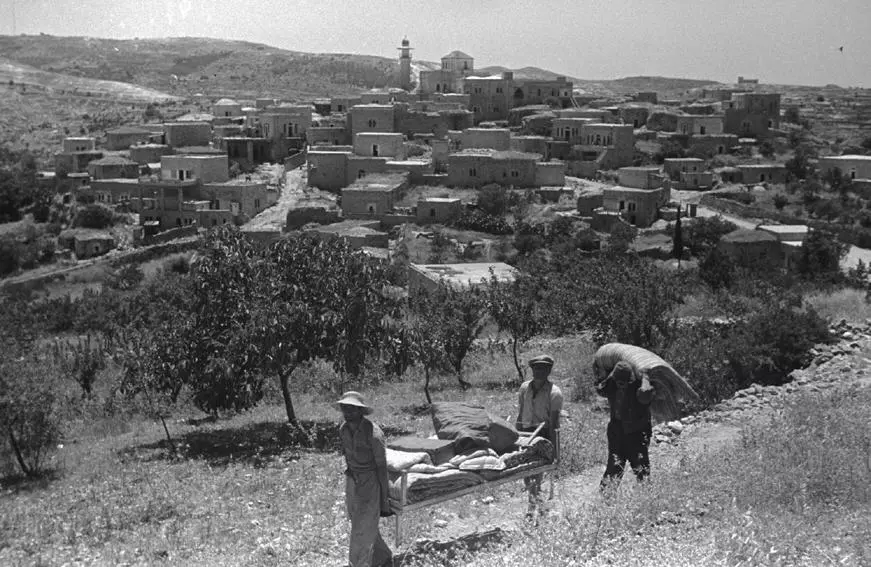
The dominant agriculture, language, foods and culture in Palestine is Arab. Take for example, a friend of mine who was driven from his village of Al-Jammasin in 1948 by the Israeli terrorist group, the Haganah. The eastern side of al Jammasin were buffalo farmers [jāmūs is the Arab word for buffalo]. My friends family lived in the west, producing the famous Jaffa oranges for export to Europe. Prior to the 19th century, my friend’s family were Bedouins from Jordan.
.jpg)
Palestinian people of the village Al-Jammasin in the precinct of Jaffa grew citrus for generations before Zionist settlers came in 19th and 20th centuries.
Long before Israel was mandated as a country, Jaffa oranges were famously exported to Europe and to the U.K. in particular.
My friends family lived in harmony with Jewish people in the region until the Zionists came. Many Jews lived in nearby Tel Aviv.
My friends family lived in al Jammasin from the 1800s. Before that they were Bedouins from the Jordan area. The whole area of the Levant is a creation of migration up through the Rift Valley for thousands of years. There were many semitic tribes but most were Arabs. [What is an Arab is a more complex question, too big to go into here (personally I am skeptical of race as a meaningful description of humanity)].
We do know that Palestinian culture is Arab culture, but it is distinctive in dress, in food and even in language. If you go to any of the demonstrations in Sydney, Melbourne or Brisbane you will see women dressed in distinctive.

For example in the film Farah the Palestinian woman were wearing thobes that tend to be intricate and reflect the bride’s unique heritage. Each one is different, memorable, and a tribute to her region and family.

At a Palestinian wedding there are celebratory dakbe dances where all participants hold hands and do a series of intricate dance steps, including tapping and stomping. The stomping is the action of a farmer planting the soil. There are a lot of other movements, too, like jumps and twists.
In 1948 the residents of al Jammasin did not want war with the terrorist Hagannah. Many fled, including my friends family. Those who remained promised the armed settlers in Haganah that they would not to harbour any Arab Liberation Armies or local Arab Militia. They further promised that, in the case they were not able to keep them out alone, they were to call on Haganah for help. The Jammasin villagers, together with Abu Kishk, also jointly approached a Jewish police officer at Ramat Gan. [From wikipedia … https://en.wikipedia.org/wiki/Bilad_al-Sham%5D
At first my friends family were forced to live in caves, then tents supplied by the United Nations and finally they moved to a refugee camp in Nablus on the road to Jenin. They live there to this day exiled from their own lands constantly threatened by IDF soldiers and finding it difficult to obtain work since 7 October 2024.

Conclusion
My friends family had lived in al Jammasin growing oranges for 100 years before the al Nakba in 1948, until they were driven out by post-war settlers from Europe organised by the terrorist group, the Haganah. In 1977, it was Menachem Begin (the leader of both the Haganah and later the Likud Party) who first came up with the slogan “From the river to the sea …” The Likud won that election and Netanyahu has been carrying out the tradition of ethnic cleansing of Palestinians that it created.
Ian Curr
12 Feb 2024
The name Bilad al-Sham in Arabic translates as “the left-hand region”. It was so named from the perspective of the people of the Hejaz (western Arabia), who considered themselves to be facing the rising sun, that the Syrian region was positioned to their left, while to their right was al-Yaman (“the right-hand-region”).